The Dream That Lives On

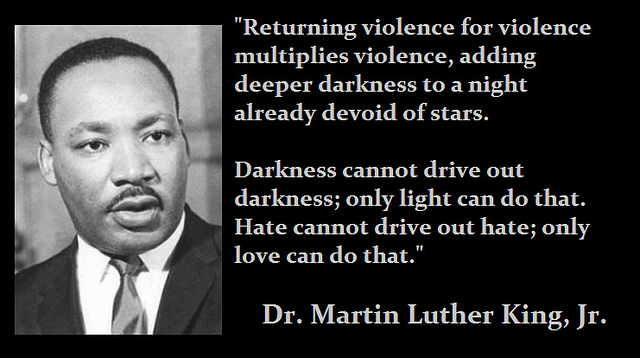
Paulsasleepwalker- MLK-Nonviolence


I am not black and cannot imagine what it feels like to experience the dark side of discrimination. I don’t understand what it feels like, but I do believe we need to get past discrimination – of any kind. I yearn for the day when we can agree or disagree on something, and that something has nothing to do with the color of anyone’s skin.

I will never forget the day Dr. Martin Luther King, Jr. died, a day that has affected the rest of my life. I remember the shame of a young classmate expressing prejudice, and I knew instinctively that prejudice was wrong. I was very young – only 8 – when he died, but I still recall that next April morning, walking to grade school in the bright sunlight. The brightness of the sun was in stark contract to the dark emptiness I felt for Dr. King’s death and the hatred that caused it. Continue reading

The Freedom In Defying Stereotypes

via The Daily Caller  by Ginni Thomas

via The Daily Caller
by Ginni Thomas

One thing that is a constant theme for me, something that is always just beneath the surface of my thinking, one that is continually rising to the top, is the truth that people are not stereotypes. I am probably as guilty as anyone of stereotyping. Sometimes stereotyping is useful, but we must never forget that people are not stereotypes.  Stereotyping people into groups, and stereotyping groups themselves, can be an impediment to truth, real dialogue and effective communication and understanding.

Sometimes, we even allow ourselves to fit into stereotypes by not thinking or acting independently apart from the collective.

It seems to me that some stereotypes are more “popular” than others at different times in our societal history, and that our history has been a series of societal movements to break those stereotypes. Race, gender, sexual orientation and many other categories of people and groups that have been stereotyped have gone through a collective metamorphosis. Currently popular stereotypes are of “homophobes”, Christians, conservatives, the news media and, yes, liberals too.

There was a time in our history in which African Americans were stereotyped and, therefore, categorized, segmented and dismissed by society as a whole. People thought ignorantly that blacks were inferior. Brave black men and women, who were highly intelligent and motivated, dared to show this stereotype was not true. The broke the stereotype by becoming educated and succeeding, in spite of all the obstacles.

The problem with stereotyping on a personal level is that it creates barriers between people. On a societal level, when stereotyping takes hold in popular culture, it creates barriers between people and people groups and segments of society. Those barriers have political, cultural, social and economic consequences. They feed and perpetuate biases and prejudices. We buy into to those thought patterns of others and even ourselves sometimes without realizing it.

Stereotypes can be insidious, and calling them out subjects them to scrutiny and diffuses them.  When stereotypes form unseen and prevail, they can be destructive. When stereotyping becomes so prevalent as to rise to the level of national (or popular) consciousness and begin to receive scrutiny, they inevitably begin to break down. When we become conscious of the stereotypes that inform modern, popular culture, we begin to see people stand out who do not fit the pattern. These are the brave pioneers who dare to be different, who purpose not to be defined by the categories others make for them. In this way, they and others who recognize them begin to break the patterns and encourage others to have the same freedom

This can be along, slow process when stereotypes become ingrained. Stereotyping of African Americans continued long after slaves were freed and civil rights passed and vestiges continue to persist today. I am struck, however, by the notion that stereotypes evolve. They come and go. In a weird way, “popular” stereotypes become opportunities for real change once they are recognized. .

In present culture, one of those stereotypes is that minorities are all liberals. Minorities who are not liberal are treated as rebels, outcasts, traitors. They are shunned by the “group” that claims them and demands they step in line. This is stereotyping. Stereotyping does not account for the fact that people are individuals and are not defined by the common expectations others have for them.

I was led there by a post on Facebook of a piece on a black, female professor taking issue with current Democratic politics. (Available here if you are curious.) It seems there is a rising tide of educated, black conservatives who are breaking down the stereotype that the Democratic party is the minority party. I think this is a good and healthy change. Racism is an extreme example of stereotyping. The very idea that all people of color should affiliate with one political party is stereotyping; in fact it is racism – it perpetuates the idea that all people of one race are the same, think the same, act the same and can be defined in the same way.

Stereotyping can be a way of categorizing and dismissing, but exposing stereotypes can be a catalyst for societal change. As people visibly break the stereotypical molds, change occurs. Real change does not come from legislation or demagoguery; real change comes from people stepping out boldly and daring to be different. Real changes comes from people who defy stereotypes and show the way for others to unchain themselves and embrace the freedom to define themselves.
Tribute to Nelson Mandela

From history.com  (Photo Credit: Corbis)

From history.com
(Photo Credit: Corbis)

The world mourns the death of a great man today, Nelson Mandela. On the way into work, I listened to an interview with Johnny Clegg, a white British man, who formed the first integrated rock band in South Africa. He wrote Asimbonanga ((Mandela) in 1987.

Mandela was in prison at the time. He was imprisoned for 27 years. His release came in 1990.

It was illegal at the time Johnny Clegg wrote the song to possess even the likeness of Nelson Mandela in South Africa. Before reading further, take a moment to watch Johnny Clegg perform Asimbonanga in 1999 with Nelson Mandela making an appearance.

Chorus:
 
Asimbonanga——————–(we have not seen him)
Asimbonang’ umandela thina—–(we have not seen mandela)
Laph’ekhona——————–(in the place where he is)
Laph’ehleli khona————–(in the place where he is kept)
 
Oh the sea is cold and the sky is grey
Look across the island into the bay
We are all islands till comes the day
We cross the burning water
 
Chorus….
 
A seagull wings across the sea
Broken silence is what I dream
Who has the words to close the distance
Between you and me
 

Clegg explained in the interview I heard this morning that the song was inspired by the Poet, John Dunne, who wrote “no man is an island”. The meaning of the words written by Clegg were that as long as Mandela was imprisoned and separated from the nation, all people were separated from each other.

The song was prophetic, in that Mandela was freed in 1990. He went on to become President of South Africa, a country in which a very short time before would not allow white people and black people to interact legally. The lifting of Apartheid brought the people of South Africa together; it lifted the weight of Apartheid from the shoulders of all South Africans, black and white, said Johnny Clegg.

Nelson Mandela is a man who stood strong against the evil of separation. He did it not with violence or anger, but with peace and love. He did it by refusing to succumb to the pressures that make people bitter, hateful and spiteful. He did it by loving himself, his people, his captors and everyone who met him. He was a light in the dark night of Apartheid by refusing to let Apartheid define him.

Imagine having spent 27 years in prison for nothing other than being black and refusing to accept the man-made separation between people of different colored skin. Yet, he did not allow the wrong of Apartheid to conform him to its image; he did not allow Apartheid to harden his own heart; he did not allow it to create separation in his own heart between himself and the people who created the separation.

Nelson Mandela found a higher perspective, and he lived it. By living it, he paved the way for change. He showed the world how real change is affected. It is affected by standing firm on higher principles, self-sacrifice, refusing to bend to hate and responding to everything and everyone with an unwavering love. This is a very short summary of the impact Nelson Mandela had in the world in which he become the catalyst for dramatic change on this day after Nelson Mandela’s death at the age of 94: Nelson Mandela’s Release from Prison

Crossing the Racial Divide

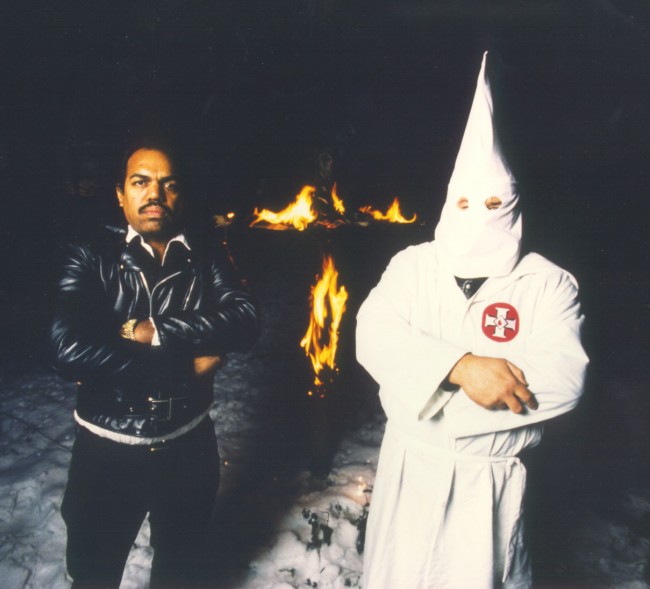
DD-at-KKK-Rally-in-Maryland-650x589Everyone gravitates toward people and people groups that are “like us”. We see it in all facets of life. The tendency to associate with our “own kind” begins early in life, on the playground. Kids tend to form cliques. They give themselves names like, jocks, nerds goths, burnouts,  and so on. Consider the classic “no girls allowed” sign under the treehouse.

This tendency is very human. The athletes stick together; the smart kids stick together; fraternities and sororities stick together; Italians, Irish, Mexicans, whatever people make up the current immigrant wave, stick together. The poor associate with the poor, and the rich associate with the rich.

The racial divide is, perhaps, the most ugly example of this tendency in our country, and one that we still deal with after many years of “equal protection under the law” and civil rights movements and ant-discrimination statutes. Continue reading