 I read a short, but very insightful, article on youth sports that strikes me as very good advice after six children of my own and 22 years of coaching them and other kids. You can read the article here: The Only Six Words Parents Need to Say to their Kids about Sports.
It is very simple, but many people “get it wrong”. I include myself in that statement. It took me much of those 22 years for me to learn what is important with kids and sports. I might finally understand.
Like the article says, team and individual sports can be tremendous character builders, instilling lifelong lessons like team work, dealing with winning and losing, overcoming fears and anxieties, leadership, sacrifice, discipline, hard work, goal setting and many, many more things. The problem is that parents, and coaches, sometimes do more damage than good and sometimes negate the lessons that are there to be learned.
I feel like I need to let parents in on a little, nasty secret. Not every kid is going to be a superstar. The six year old “stars” are not necessarily the twelve year old stars or the high school varsity stars. In fact, there really are not that many stars. Even the stars are not always going to shine. The star little leaguer or varsity player in Everytown, USA is probably not going to be a scholarship athlete, let alone a professional athlete. (Do not tell them though! They will figure it out soon enough.)
The percentages are infinitesimally small the number athletes who get athletic scholarships for college and infinitesimally smaller yet the number of athletes who will make a living at any professional athletic level.
Let your kids be kids and be satisfied that they have fun, work hard and develop some life lessons along the way. In fact, if they do not have fun, do not work hard and do not pick up any character from youth sports, they are missing the best part!
Winning and losing are their own proving grounds without much help from you. Not everyone gets a medal. There are clear winners and losers. Kids know that. Emphasize the fun, the benefits of working hard and the nuggets of character building lessons, and the rest will take care of itself.
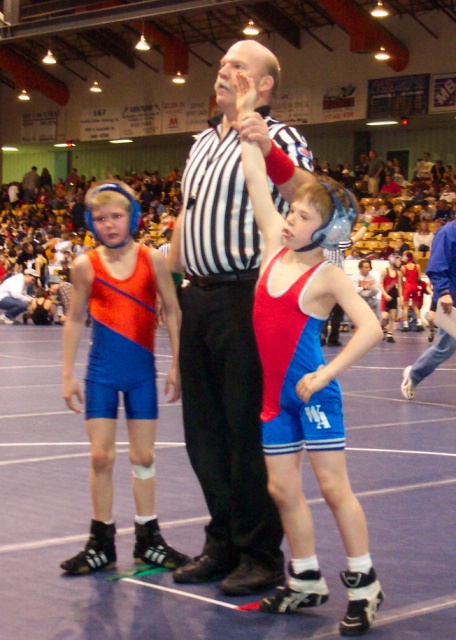
One of my favorite stories, one of the times I think I got it right, was when my 20 year old was about 10 or 11. He wrestled and was pretty good, but one opponent “had his number”. They met up at the kids regional qualifier for state for a place match. It was a battle. The other kid led most of the match, but my son fought hard and tied it up in the last seconds of the third period. In overtime, it was scoreless until the very end, when the other kid managed a takedown to win it.
Both kids literally fell over from exhaustion, completely spent! They both lay there, unable to get up, even after the referee, impatiently wanting to move on after a long day, told them to “Get up!” They had both used every last ounce of strength and stamina and could not move.
I told my son how proud I was when the impact of another loss showed on his face afterwards. I pointed out that he “left it all on the mat”, and the other kid did too, and that is all anyone could ask. I reminded him of that match often, and I still do, and he always smiles.

 Perspective
You must be logged in to post a comment.