Youth Sports from the Rear View Mirror

Young Nicholas WinI read a short, but very insightful, article on youth sports that strikes me as very good advice after six children of my own and 22 years of coaching them and other kids. You can read the article here: The Only Six Words Parents Need to Say to their Kids about Sports.

It is very simple, but many people “get it wrong”. I include myself in that statement. It took me much of those 22 years for me to learn what is important with kids and sports. I might finally understand.

Like the article says, team and individual sports can be tremendous character builders, instilling lifelong lessons like team work, dealing with winning and losing, overcoming fears and anxieties, leadership, sacrifice, discipline, hard work, goal setting and many, many more things. The problem is that parents, and coaches, sometimes do more damage than good and sometimes negate the lessons that are there to be learned.

I feel like I need to let parents in on a little, nasty secret. Not every kid is going to be a superstar. The six year old “stars” are not necessarily the twelve year old stars or the high school varsity stars. In fact, there really are not that many stars. Even the stars are not always going to shine. The star little leaguer or varsity player in Everytown, USA is probably not going to be a scholarship athlete, let alone a professional athlete. (Do not tell them though! They will figure it out soon enough.)

The percentages are infinitesimally small the number athletes who get athletic scholarships for college and infinitesimally smaller yet the number of athletes who will make a living at any professional athletic level.

Let your kids be kids and be satisfied that they have fun, work hard and develop some life lessons along the way. In fact, if they do not have fun, do not work hard and do not pick up any character from youth sports, they are missing the best part!

Winning and losing are their own proving grounds without much help from you. Not everyone gets a medal. There are clear winners and losers. Kids know that. Emphasize the fun, the benefits of working hard and the nuggets of character building lessons, and the rest will take care of itself.

One of my favorite stories, one of the times I think I got it right, was when my 20 year old was about 10 or 11. He wrestled and was pretty good, but one opponent “had his number”. They met up at the kids regional qualifier for state for a place match. It was a battle. The other kid led most of the match, but my son fought hard and tied it up in the last seconds of the third period. In overtime, it was scoreless until the very end, when the other kid managed a takedown to win it.

Both kids literally fell over from exhaustion, completely spent! They both lay there, unable to get up, even after the referee, impatiently wanting to move on after a long day, told them to “Get up!” They had both used every last ounce of strength and stamina and could not move.

I told my son how proud I was when the impact of another loss showed on his face afterwards. I pointed out that he “left it all on the mat”, and the other kid did too, and that is all anyone could ask. I reminded him of that match often, and I still do, and he always smiles.

The Dream That Lives On

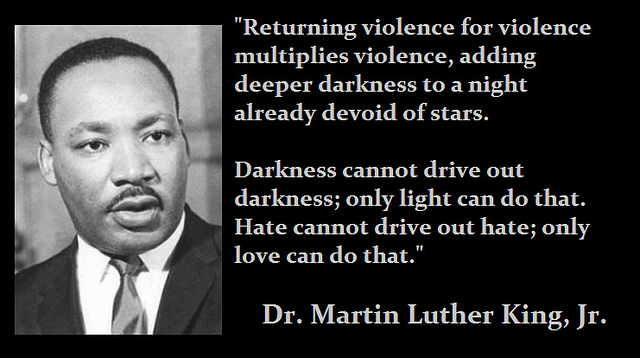
Paulsasleepwalker- MLK-Nonviolence


I am not black and cannot imagine what it feels like to experience the dark side of discrimination. I don’t understand what it feels like, but I do believe we need to get past discrimination – of any kind. I yearn for the day when we can agree or disagree on something, and that something has nothing to do with the color of anyone’s skin.

I will never forget the day Dr. Martin Luther King, Jr. died, a day that has affected the rest of my life. I remember the shame of a young classmate expressing prejudice, and I knew instinctively that prejudice was wrong. I was very young – only 8 – when he died, but I still recall that next April morning, walking to grade school in the bright sunlight. The brightness of the sun was in stark contract to the dark emptiness I felt for Dr. King’s death and the hatred that caused it. Continue reading

Who is More Charitable?

charity road sign arrowAs I was driving home from the office tonight, a conversation on NPR got me thinking. The participants in the discussion clearly assumed that conservatives are less generous than liberals. They recited the reasons why conservatives opposed certain legislative initiatives as if they had the blue print to the conservative mind and heart…. , but did they?

I decided to research the matter as best I could. This is what I found:

The first thing I found was from the Democratic Underground. Based on a study done in 2008 by the Internal Revenue Service of taxpayers throughout the country, The Chronicle of Philanthropy reported, “The eight states where residents gave the highest share of income to charity went for John McCain in 2008. The seven-lowest ranking states supported Barack Obama.” The middle class earners (making $50,000-$75,000) were more generous than those making more than $100,000. The more deeply religious areas of the country were more generous than the less religious areas of the country.

George Will, of course, cites the Brooks Study. He points out that Brooks is a self-labelled independent and was surprised by the data, so surprised that he initially thought it was faulty. Among the findings were these: 1) “Although liberal families’ incomes average 6 percent higher than those of conservative families, conservative-headed households give, on average, 30 percent more to charity than the average liberal-headed household ($1,600 per year vs. $1,227)”; 2) “Bush carried 24 of the 25 states where charitable giving was above average”; 3) “People who reject the idea that “government has a responsibility to reduce income inequality” give an average of four times more than people who accept that proposition”; 4) “America is largely divided between religious givers and secular nongivers, and the former are disproportionately conservative. One demonstration that religion is a strong determinant of charitable behavior is that the least charitable cohort is a relatively small one — secular conservatives”; 5) Democrats represent a majority of the wealthiest congressional districts, and half of America’s richest households live in states where both senators are Democrats”; 6) “Vice President Al Gore’s charitable contributions, as a percentage of his income, were below the national average: He gave 0.2 percent of his family income, one-seventh of the average for donating households. But Gore “gave at the office.” By using public office to give other peoples’ money to government programs, he was being charitable, as liberals increasingly, and conveniently, understand that word.”

From the freerepublic.com citing John Stossel – all but one of the top 25 charitable states voted Republican in the 2004 election; and Stossel noted, “Conservatives are even 18 percent more likely to give blood.” Quoting  Professor Arthur Brooks of Syracuse University, author of the 2007 book Who Really Cares, “When you look at the data, it turns out that conservatives give about 30 percent more. And incidentally, conservative-headed families make slightly less money; “and people who believe it’s the government’s job to make incomes more equal, are far less likely to give their money away.”

From the New York Times, in an article by self-described liberal, Nicholas D. Kristoff, he says, “Liberals show tremendous compassion in pushing for generous government spending to help the neediest people at home and abroad. Yet when it comes to individual contributions to charitable causes, liberals are cheapskates.” A Google study revealed that conservatives give almost double what liberals give in proportion to their income. Kristoff says, “It’s true that religion is the essential reason conservatives give more, and religious liberals are as generous as religious conservatives. Among the stingiest of the stingy are secular conservatives”; and “if measuring by the percentage of income given, conservatives are more generous than liberals even to secular causes.” And another bomb: “liberal donations frequently sustain art museums, symphonies, schools and universities that cater to the well-off. (It’s great to support the arts and education, but they’re not the same as charity for the needy. And some research suggests that donations to education actually increase inequality because they go mostly to elite institutions attended by the wealthy.)” Finally, “People in red states are considerably more likely to volunteer for good causes, and conservatives give blood more often. If liberals and moderates gave blood as often as conservatives, Mr. Brooks said, the American blood supply would increase by 45 percent.”

In going through two pages of responses to my query on Google (who gives more to charity, Democrats or Republicans), I begin to come across commentaries on the same studies over and over. So I stopped. There were some pieces calling the studies into question, suggesting reasons for the differences, observing that religious people tend to give to churches and secular people tend to consider their tax money their giving and noting studies by several universities suggesting that the purpose for the giving triggers more giving alternately for conservatives or liberals, depending on the expressed purpose.

In the end, and without doing any independent research, it seems that Republicans, and conservatives, especially religious conservatives, give more to charity – though religious liberals are also liberal in their giving; while secular conservatives are the least charitable. According to the assumptions clearly couched in the discussion I heard, one would think that all Republicans are secular conservatives; but secular conservatives also had the smallest numbers of the groups studied.  I have no way of confirming the data independently, but I am satisfied, at least, that the assumptions were incorrect. Republicans/conservatives are not less charitable than Democrats/liberals (thought they may be much less adept in conveying their charitable inclinations, or at least are less public about their charity); if anything they are more charitable.

The Freedom In Defying Stereotypes

via The Daily Caller  by Ginni Thomas

via The Daily Caller
by Ginni Thomas

One thing that is a constant theme for me, something that is always just beneath the surface of my thinking, one that is continually rising to the top, is the truth that people are not stereotypes. I am probably as guilty as anyone of stereotyping. Sometimes stereotyping is useful, but we must never forget that people are not stereotypes.  Stereotyping people into groups, and stereotyping groups themselves, can be an impediment to truth, real dialogue and effective communication and understanding.

Sometimes, we even allow ourselves to fit into stereotypes by not thinking or acting independently apart from the collective.

It seems to me that some stereotypes are more “popular” than others at different times in our societal history, and that our history has been a series of societal movements to break those stereotypes. Race, gender, sexual orientation and many other categories of people and groups that have been stereotyped have gone through a collective metamorphosis. Currently popular stereotypes are of “homophobes”, Christians, conservatives, the news media and, yes, liberals too.

There was a time in our history in which African Americans were stereotyped and, therefore, categorized, segmented and dismissed by society as a whole. People thought ignorantly that blacks were inferior. Brave black men and women, who were highly intelligent and motivated, dared to show this stereotype was not true. The broke the stereotype by becoming educated and succeeding, in spite of all the obstacles.

The problem with stereotyping on a personal level is that it creates barriers between people. On a societal level, when stereotyping takes hold in popular culture, it creates barriers between people and people groups and segments of society. Those barriers have political, cultural, social and economic consequences. They feed and perpetuate biases and prejudices. We buy into to those thought patterns of others and even ourselves sometimes without realizing it.

Stereotypes can be insidious, and calling them out subjects them to scrutiny and diffuses them.  When stereotypes form unseen and prevail, they can be destructive. When stereotyping becomes so prevalent as to rise to the level of national (or popular) consciousness and begin to receive scrutiny, they inevitably begin to break down. When we become conscious of the stereotypes that inform modern, popular culture, we begin to see people stand out who do not fit the pattern. These are the brave pioneers who dare to be different, who purpose not to be defined by the categories others make for them. In this way, they and others who recognize them begin to break the patterns and encourage others to have the same freedom

This can be along, slow process when stereotypes become ingrained. Stereotyping of African Americans continued long after slaves were freed and civil rights passed and vestiges continue to persist today. I am struck, however, by the notion that stereotypes evolve. They come and go. In a weird way, “popular” stereotypes become opportunities for real change once they are recognized. .

In present culture, one of those stereotypes is that minorities are all liberals. Minorities who are not liberal are treated as rebels, outcasts, traitors. They are shunned by the “group” that claims them and demands they step in line. This is stereotyping. Stereotyping does not account for the fact that people are individuals and are not defined by the common expectations others have for them.

I was led there by a post on Facebook of a piece on a black, female professor taking issue with current Democratic politics. (Available here if you are curious.) It seems there is a rising tide of educated, black conservatives who are breaking down the stereotype that the Democratic party is the minority party. I think this is a good and healthy change. Racism is an extreme example of stereotyping. The very idea that all people of color should affiliate with one political party is stereotyping; in fact it is racism – it perpetuates the idea that all people of one race are the same, think the same, act the same and can be defined in the same way.

Stereotyping can be a way of categorizing and dismissing, but exposing stereotypes can be a catalyst for societal change. As people visibly break the stereotypical molds, change occurs. Real change does not come from legislation or demagoguery; real change comes from people stepping out boldly and daring to be different. Real changes comes from people who defy stereotypes and show the way for others to unchain themselves and embrace the freedom to define themselves.

A Long Slow Divorce: My Sports Journey

Tanner & JonathanWhen I was a kid, I was a true sports fan. Sports was a central theme of family get-togethers. We watched whatever seasonal sport was showing, and discussions at family gatherings always drifted to sports. The thrill of victory and agony of defeat ran through my veins and informed my dreams.

I read books from the 50’s and 60’s of improbable feats of heroism by ordinary athletes and teams. I religiously watched the Cubs, Bears and Blackhawks play on television and listened on radio. I swung a baseball bat for hours alone perfecting my swing and pitched tennis balls endlessly against a garage or brick wall with visions of a major league career running through my head. I galloped through backyard football games with a ball tucked under my arm like the ghost of Gale Sayers, replaying in my mind each night the highlight reel of my performance. My brother and I even played makeup hockey, baseball and football  games with any objects we could find for pucks, sticks, bats and balls – just the two of us.

Some of my earliest sports memories were watching the “Galloping Ghost”, Gale Sayers, run the Wrigley Field gridiron and Ernie Banks, Ron Santo and Billy Williams launch home runs from that same hallowed ground transformed to a diamond. Other icons of my early memories included Bobby Hull, Stan Makita and Tony Esposito, who brought Chicago as close to sports nirvana as my beloved Cubs.

The allure of the world of sports, however, began to unravel not long thereafter. When Wertz terminated the Blackhawks contract with WGN, relegating hockey to the snowy underworld of UHF TV, I was probably 9 or 10. I lost my taste for hockey and never regained it.  I was too young yet to appreciate fully why the Bears home games were not televised. I was very much cognizant; however, of the betrayal I felt when my beloved Cubs traded away Bill Matlock after he won the National League batting crown. The beginning of sports free agency did much damage to my preteen sports psyche. My heroes were not supposed to be traded away like commodities. Worse, they were not supposed abandon my loyalty to the Cubbie Blue. Ken Holtzman, Ron Santo and others followed.

Around the same time, I was introduced to a new sport. The 1972 Olympics in Munich featured what may be the most renowned American freestyle wrestling team our country has known, led by the inimitable Dan Gable. He was a different breed. He won gold without a single point scored against him and was the heart of that Olympic team that took home a many medals.

I became a wrestler that year as a 7th grader. Wrestling was a different kind of sports experience. People did not talk about wrestling. While other sports were all about the communal glory and acclaim of victory, wrestling was grind-it-out hard; no one knew much about it or talked about it; and the victories to be won were as much about overcoming doubts and fears in the heart as about prevailing in competition.

Most teenage boys inevitably find other things that are more alluring than sports as hormones kick in. I was no different. I ran track, played football and baseball, and I wrestled through my teen years, though other things captured my heart. I also abandoning one by one the sports of my youth until only wrestling remained. I carried wrestling into college where academics and other things took on more importance. The ideal of sports gave way to other ideals: the pursuit of knowledge, faith, and a soulmate, among others.

Though it is common for other things to take center stage as life goes on, sports remain a common denominator and topic of discussion and debate for most. It is part of our culture. Sports performances can be ennobling. Who does not remember the inspired performance of the 1980 Olympic Hockey team’s win over the Soviet Union? Michael Jordan’s ability to carry the Bulls to victory on his shoulders and to hit that last jump shot at the buzzer to synch the victory is the stuff of legend. But the luster had long begun to fade for me as I hit adulthood.

It turns out Michael Jordan was human. He gambled. He had a midlife sports crisis. He got divorced. Baseball, football and hockey strikes and lock outs each took their toll. Money has become the heart and soul of professional sports in a way that was not true, or at least not evident, when I was young. Money is a common theme that runs through professional sports, obscene amounts of it. Money dominates talk of college football and college basketball (all wanting a piece of the golden pie). Money, too, it turns out, runs through the veins of the Olympic movement, which seems to have stalled in the sludge of creeping commercialism.

The Olympic ideal began to tarnish with Communist regimes fashioning state sponsored, hand-picked athletes into finally tuned and performance enhanced machines. The fiction of amateur status could not be maintained. The victory of the US hockey team in 1980 was all the more legendary for the fact that the team was amateur David taking on the Soviet Goliath supported by the state. Now any professional can play in the Olympics. The professionals have not only tarnished the shiny Olympic finish, they have cheapened the games. Basketball in the Olympics is just a side show for the NBA. Perhaps the last nail in the coffin for me was the recommendation of the International Olympic Committee to remove wrestling from the Olympics.

For better or worse, money has not tainted wrestling, at least not at its core. There is no money in it.

I do not watch professional sports – at all – anymore. I have not watched a full baseball, football, hockey or basketball game in years with rare exception. I do not go to professional sports events. I have a hard time seeing  past the taint of money and the betrayal of the ideal that once illuminated a young heart and soul.

My sports heroes are, now, my sons who wrestle and their (my) fellow wrestlers. They and their fellow wrestlers (men and women) have my admiration and respect and remind me of what is good and wholesome and inspiring in sports. The hard work and dedication is unparalleled. There is no fame or fortune awaiting them. They do it only for the thrill of victory. They forge their character in the agony of defeat and the countless hours, the blood and the sweat, the focus and commitment it takes to overcome fears, doubts, temptations to take an easier road and all of the obstacles that life can bring to gain the ultimate prize of being, simply, the best of the best.

The glory and acclaim in wrestling is no less communal than professional sports, but it is a small community – more like a sisterhood and brotherhood. It is more like family than community, and it is, perhaps therefore, a stronger tie.

My 24 year old announced in December 2013, after 15+ years of wrestling that he was done. He spent the previous 5 years chasing the Olympic dream, coming within sight of it, yet being just out of its grasp. The injuries demanded their price. The sacrifices no longer made sense. It was not the way he or I hoped it would come to an end, but there is a season for everything under the sun. That season is now over. The journey built deep character and will be cherished.

Just months ago the elite executive board of the International Olympic Committee announced its recommendation to drop wrestling from the Olympics beginning in 2020. It came like a slap in the face. What could be more Olympic  than wrestling? What is more characteristic of the Olympic ideal than the World’s oldest sport? It was not only one of five sports in the ancient Olympics, wrestling was considered chief among them. It was at the foundation of the modern Olympic movement.

The IOC reported through a spokesman that they want to look to the future. Wrestling does not have television appeal.

The IOC seems to want fads, not ideals. Wrestling is apparently is not “sexy” enough, but sexy wears off. True love is not sexy. Ideals do not become obsolete.

For now, wrestling is back in the Olympics. The full IOC voted in September to reinstate wrestling as an Olympic sport. I fear, however, that the future of the Olympics will only be about money, TV ratings and trendy things. The IOC committee recommendation to eliminate wrestling is an omen. We have seen the future, and I do not like it.

The love of sports for me has been a long slow divorce. I will never watch another Olympics without wrestling. For now there is reconciliation, but I fear the Olympics will go the way of hockey and other professional sports have gone for me. I hope that wrestling survives; but if wrestling does not survive, the divorce will be complete.

Tragic Irony and A Newtown Example

Heinz Kluetmeier for Sports Illustrated

Heinz Kluetmeier for Sports Illustrated

We are too often reminded of the evil that lurks in the human heart, yet we react in shock whenever and wherever it erupts. The examples are the favorite children of the media, the fertile ground for growing readership. We recoil from senseless acts of depravity almost as much as we stop and stare at these train wrecks that are memorialized before us and etched into our collective minds by print and other forms of media. We fixate on them and exorcise them by appropriate judgment and disdain for the insensibility of deranged souls that star in these real life dramas, but these tragedies and our reactions to them also reveal some ironic human tendencies.

We are often not moved to great acts of goodness, except in reaction to tragedies. The more exposure to tragedies, difficulties and hardships, especially ones that do not affect us, the less likely we are to be moved by them to help others. When tragedy hits too close to home, we can be crippled into inaction; while the same tragedy experienced from a greater distance inspires others to action.

Fortunately, for most of us, tragedies happen to “other people” and rarely hit close to our homes. Perhaps unfortunately for those of us so lucky to avoid the direct fall out of a tragedy, the shock waves quickly dissipate as we go on with our daily lives. Not many of us are able to shake off the sleep that sets in with daily routines in a way that affects any change. The emotion fades quickly to a factual memory, stored away with historical dates and numbers and other tidbits.

I dare say that we tend to remain largely unaffected by distant tragedies after the initial  shock wears quickly off.

People are a funny lot. When things happen to others, we are not nearly so affected as when they happen to us, or close to us. When tragedy hits close to home, we tend to be deeply affected, and often deeply changed. The people who have been personally affected by tragedy, difficulty or hardship are the ones who devote themselves to helping others with similar experiences. Charitable organizations are often founded by people affected by the particular issues that the charities are formed to address. In this way, some people reap the fortune of other people’s tragedies.

Almost every tragedy, whether it comes from human action, natural events or other ways, triggers an outpouring of generosity, kindness, good will and even heroism. The Sandy Hook shooting, 9/11 and many other human tragedies are followed by these outpourings of good. It occurs to me that this phenomenon is kind of like Newton’s Third Law of physics (every action has an equal and opposite reaction). For every evil that occurs, people are inspired to react with great goodness.

There is certainly some irony in that. I am not sure why tragedies bring out the best in people. Maybe we are too easily dulled by everyday life into forgetting that people are in need all around us. It takes a catastrophic event, and clear evidence of need, to spur us to good actions. We are shocked into reacting. Tragedies caused by other people, perhaps, spur reaction as if the reaction, itself, can redeem the human race.

No one would wish for tragedy to inspire goodness. Yet, tragedies do inspire goodness. We cannot avoid many natural tragedies like tornados, cancer and things out of our control, but there are things we can do to avoid man-made tragedies like the Sandy Hook shooting. A different kind of action is required to avoid these senseless actions by people. It takes pro-action instead of reaction. It takes intentional action in our everyday lives to be kind, generous, sensitive to others and willing to give ourselves to better others around us.

If we all lived intentionally like that every day in our lives, we would not have as many outcast, downtrodden and tortured souls who end up acting on their impulses – and reactions to “evils” they have experienced – that results in tragedies like the Sandy Hook shooting.

My inspiration for this piece actually comes out of the Sandy Hook shooting. The inspiration is a fourteen year old boy, Jack Wellman of Newtown, Connecticut, who is living the example of this kind of proactive life. He has turned his own setbacks, difficulties and “tragedies” into opportunities to help others in small, daily ways that have a very positive impact on those around him and his community. What I like about this story is that it overlaps with the Sandy Hook tragedy, but Jack Wellman was living this life before the tragedy occurred, and he continued to live this way in spite of his own struggles with grief that threatened to overwhelm him when tragedy hit his hometown.

Just as tragedy can spur heroic and good reactions, it can cripple action with grief and despair. Jack Wellman stands in contrast to Newton-like reactions we sometimes see and experience (or should I say Newtown-like reactions?). Tragedy did not spur Jack Wellman’s action, and tragedy did not stop him from acting either.

This is the beauty of the human soul. We do not have to be instinctual, reactive beings, though we often are. We have the freedom to rise above those things and be our own agents for action and change. We can all be Jack Wellmans.

If you have time, please follow this link to read the story of Jack Wellman in Sports Illustrated for Kids. Jack Wellman is the 2013 Sports Illustrated Kid of the Year. It is well worth your time.