Unto Us a Child Is Born

canstockphoto7454869


The prophet Isaiah, spoke of the birth of Jesus Christ over 700 years before Jesus was born according to those who followed Him in the 1st Century. There should be no doubt that the man, Jesus of Nazareth, born in Bethlehem, was an actual historic figure. That the man, Jesus, lived and died on a cross and had a great following is also a historic fact. 

Consider, then the actual words of the prophet, Isaiah:

For a child will be born to us, a son will be given to us; and the government will rest on His shoulders; and His name will be called Wonderful Counselor, Mighty God, Eternal Father, Prince of Peace. There will be no end to the increase of His government or of peace, on the throne of David and over his kingdom, to establish it and to uphold it with justice and righteousness from then on and forevermore. (Isaiah 9:6-7)

At the end of this blog article is another, later, prophetic word spoken by Isaiah. The application to the historic figure of Jesus is uncanny, if it is not God speaking through Isaiah centuries before the life and death of this man, Jesus.

Continue reading

Pursuit of Happiness, Meaning and Joy

Me Walking

By Julia Drendel

The “pursuit of happiness” is guaranteed in the US Constitution. Notice that happiness is not guaranteed, only the pursuit of happiness. Nevertheless, modern American society is colored by this basic guaranty, and much of modern American life can be attributed to the sacrosanct pursuit of happiness. Many also mistake the freedom to pursue happiness with happiness itself.

We live in a world in which our lives tend to be measured by how happy we are. Many among us feel that we have a right to be happy, and many among us are disappointed, angry and even indignant when happiness eludes them. Indeed, happiness is an elusive creature. I have written on this before.

I go to thinking about the subject again as I read about, Viktor Frankl, a Viennese psychiatrist, who says this:

“It is the very pursuit of happiness that thwarts happiness.”


The statement comes at a very personal price for Frankl and his family, who were victims of the Holocaust. Only Frankl survived. His views on this subject carry some unusual weight as a result of his experience. His conclusion is that there is something far more powerful, far more important to life, than happiness – and that is meaning.

He learned early on that those who found meaning in life, even in the more horrendous circumstances, were “far more resilient to suffering than those who did not.” “Everything can be taken from a man but one thing,” Frankl wrote in Man’s Search for Meaning, “the last of the human freedoms — to choose one’s attitude in any given set of circumstances, to choose one’s own way.”

Frankl goes on to conclude that a meaningful life often leads to a happy life, but happiness pursued for its own sake usually leads to an unhappy, unfulfilled and shallow existence. Meaning, in the end, is what differentiates human being from animals. Happiness is a base feeling that is shared by humans and animals alike. Meaning is what human beings different and what we are meant for.

This is no theoretical exercise for Frankl. He lived it. He was a prodigy. He rose quickly to acclaim, becoming the chief of neurology at Vienna’s Rothschild Hospital as the Nazi threat loomed. Newly married, he obtained a visa to escape the cataclysm he knew was coming. But, he was faced with a dilemma: escape to America or stay and protect his parents. Emily Esfahani Smith describes the choice he made this way in her article in the Atlantic, There’s More to Life than Being Happy:

As Anna S. Redsand recounts in her biography of Frankl, he was at a loss for what to do, so he set out for St. Stephan’s Cathedral in Vienna to clear his head. Listening to the organ music, he repeatedly asked himself, “Should I leave my parents behind?… Should I say goodbye and leave them to their fate?” Where did his responsibility lie? He was looking for a “hint from heaven.”

When he returned home, he found it. A piece of marble was lying on the table. His father explained that it was from the rubble of one of the nearby synagogues that the Nazis had destroyed. The marble contained the fragment of one of the Ten Commandments — the one about honoring your father and your mother. With that, Frankl decided to stay in Vienna and forgo whatever opportunities for safety and career advancement awaited him in the United States. He decided to put aside his individual pursuits to serve his family and, later, other inmates in the camps.

The article focuses on the importance of meaning in people’s lives, and the enduring quality of meaning as compared to happiness. Frankl observes that giving is to meaning as taking is to happiness, and  Frankl ultimately exalts living a life of meaning as being human:

“Being human always points, and is directed, to something or someone, other than oneself — be it a meaning to fulfill or another human being to encounter. The more one forgets himself — by giving himself to a cause to serve or another person to love — the more human he is.”

But I would take it a step further.

For Frankl, the experience that led him to stay by his parents’ side, which led to his own interment in a prison camp, might be described as spiritual, but he came away with a very humanistic conclusion. Whether he made the spiritual connection, I will. The hint from heaven that he sought was provided in the fragment of the broken Ten Commandments. Was it not an answer to prayer from a personal God who heard his cry for an answer?

Maybe it was not the answer he wanted. Looking back, a different “sign” might certainly have portended a more comfortable, happier and less painful path. In fact, I could not imagine a more difficult road to walk. It may seem like some small comfort that God directed it.

But God knows the path that Frankl walked. He experienced a similar path Himself. Humbling Himself to take on human form, He humbled Himself even further – born as a vulnerable child to parents of humble means in a manger made for animals; Jesus lived a life of obedience to the Father, a life dedicated to one thing – the salvation of mankind – and he humbled Himself ultimately to submit to tortuous death at the hands of His own creation from itself.

Along the way, Jesus spoke to all mankind when he said things like, “unless a grain of wheat falls into the earth and dies, it remains alone; but if it dies, it bears much fruit” (John 12:24); and “he that is greatest among you shall be your servant.” (Matt. 23:11-12) His disciples carried on in the same direction: “Do nothing from selfish ambition or conceit, but in humility count others more significant than yourselves.” (Phil. 2:3)

The things that Frankl discovered are similar to what Jesus taught.

In my opinion, truth is truth. But there is more. While we are, indeed, something different altogether from the animals, in that we can grasp meaning, and beauty and philosophical thought, there is still something more. These things are not simply human. They are the fingerprint of God.

Indeed, we did not create ourselves. We stand in time and space, specks in the seemingly infinite canvass of time and space, subject to the travails of a Universe that balances on a razor’s edge. The Universe, itself, and all that is in it, and especially mankind, point to an Intelligent Source. Does life really spring from inanimate objects? Do reason and intelligence grow out of random and irrational processes and matter? Does a reaction cause itself?

For me, meaning must be more deeply rooted than human kind. I see in people the image of God. While so many things make so little sense in this world, I see in Christ the ultimate intention of God to lift us out of this existence that we, for whatever reason, find ourselves. In Christ is the hope of glory that is God. In relationship with God, the Intelligent Source of this Universe, is our destiny and the fulfillment of that meaning for which we have been created.

The fact that this God humbled His very Self to become as vulnerable as us, to connect with us, to direct us in the way He planned (love God and love others), to give us hope of that for which we long – eternal life in relationship  with Him in a “place” where there are no more tears, no pain and no death – is all the proof I need to know that I can trust this God. In spite, of the evil that I see, and especially the evil perpetrated by men on men, I can have faith in a God who knows us intimately, knows what it is like to be like us, and has overcome the darkness that we live in.

The happiness that we pursue to today, in this life, is nothing like the joy that awaits us. There is something greater when we tap into something larger than our individual selves. Yes, I believe there is meaning in being human and tapping into humanity, but there is joy unspeakable when we tap into something even greater than our collective selves, something greater than humanity. When we tap into God for whom, by whom, of whom and for whom we were created, we tap into the truest and highest meaning there can be.

Indeed, I believe Frankl is right, that the pursuit of happiness actually pushes off the happiness that we seek. C.S. Lewis came to a similar conclusion in Surprised by Joy, the autobiographical account of his journey from materialist atheism to Christian faith. The more he pursued the “joy” he experienced, the more elusive it became… until he discovered the Source of that Joy.

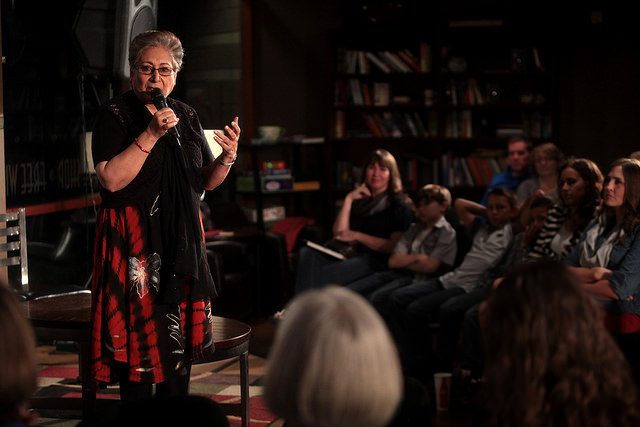
Raheel Raza on Islam by the Numbers

Raheel Raza by Gage Skidmore

Raheel Raza by Gage Skidmore

The video at the end of this piece addresses the claims that we hear from our President and other leaders in the US that Islam does not have anything to do with terrorism in the word. According to Barack Obama, 99.9% of the Muslims in the world do not support radical Islam. But is he right? Raheel Raza, a Sunni Muslim herself, gives us the facts and figures.

Raheel Raza says she does not need Barack Obama, Hillary Clinton or any celebrity, like Ben Affleck, to defend her and her religion. She says she needs to be defended from the radicals in her own religion. She needs to be defended from radical Islamists who behead people, throwh battery acid on people and murder people in the name of her God. She says these radicals seek to take over the world in the name of her religion.

A Muslim herself, Raheel Raza has dedicated her life to speaking out against the rising threat of radical Islam, which threatens to swallow up the Islam she knows. She urges that we can not treat an illness without identifying what the problem is. We cannot address the cancer of radical Islam without accurately identifying what it is.

Continue reading

A Cosmological Argument for God

Clouds over Connelly's & Utz's


A Cosmological Argument for God:

  • If the universe began to exist, then the universe has a cause
  • The universe began to exist
  • Therefore, the universe had a cause

To suppose that something sprang into being, uncaused out of nothing is worse than believing in magic, according to Dr. William Lane Craig. If a magician pulls a rabbit out of a hat, at least you start with the magician, as well as the hat. Magicians, rabbits and hats combine to trick our minds with illusion, but we know it is an illusion. We know the reality is belied by what we think we see.

Call it intuition. Call it something else. Our observation fails sometimes to provide us the complete picture, but we “know” the reality nevertheless.

Lawrence Krauss makes the case for the universe arising out of nothing. But, when he talks about nothing, he is not talking about absolutely nothing. His “nothing” is actually vacuums of energy. Something can hardly be nothing. David Albert, the philosopher of science, and Ph.D. in quantum physics, calls Krauss’s argument “wrong”, but I dare say it does not take a Ph.D. to know that Krauss cannot be right.

Krauss’s nothing, like the rabbit pulled out of a hat, simply begs the next question: where did the vacuums of energy come from? And, if the answer is simply other vacuums of energy (like other Big Bangs, or other universes, or aliens), you know what the next question will be. This reasoning is an infinite series of regress. It is an exercise in avoiding the only other plausible possibility.

The scientific evidence suggests that the reality we know had a beginning. The Big Bang theory, the expanding universe, the second law of thermodynamics, the radiation afterglow and other observations all suggest that the universe had a beginning. Tufts Professor, Alexander Vilenkin, claims to have discovered, after 35 years of tracing the universe back in time, that, prior to the beginning of the universe, there was not another universe, or aliens or anything; “there was nothing, nothing at all, not even time itself.

That, indeed is a tough pill to swallow for a scientific and intellectual community that desperately wants “something” to have always existed. Anything will do, as long as it provides an alternative to the conclusion that an uncaused Causer, an unmoved Mover got the ball rolling. That we are left with no satisfactory explanation but that some intelligence designed the universe (itself being infinite and outside of time, space and even matter) is inescapable.

Many an honest atheist concedes this point:

“Astronomy leads us to a unique event, a universe which was created out of nothing, one with the very delicate balance needed to provide exactly the conditions required to permit life, and one which has an underlying (one might say “supernatural”) plan.”

(Nobel laureate Arno Penzias, “Cosmos, Bios, and Theos,” page 83)

“An honest man, armed with all the knowledge available to us now, could only state that in some sense, the origin of life appears at the moment to be almost a miracle, so many are the conditions which would have had to have been satisfied to get it going.”

(Dr. Francis Crick, biochemist, Nobel Prize winner, Life Itself: Its Origin and Nature, pg. 88)

“There are only two possibilities as to how life arose; one is spontaneous generation arising to evolution, the other is a supernatural creative act of God, there is no third possibility. Spontaneous generation that life arose from non-living matter was scientifically disproved 120 years ago by Louis Pasteur and others. That leaves us with only one possible conclusion, that life arose as a creative act of God. I will not accept that philosophically because I do not want to believe in God, therefore I choose to believe in that which I know is scientifically impossible, spontaneous generation arising to evolution.”

(Dr. George Wald, evolutionist, Professor Emeritus of Biology at the University at Harvard, Nobel Prize winner in Biology.)

“Darwin’s theory of evolution is the last of the great nineteenth-century mystery religions. And as we speak it is now following Freudians and Marxism into the Nether regions, and I’m quite sure that Freud, Marx and Darwin are commiserating one with the other in the dark dungeon where discarded gods gather.”

(Dr. David Berlinski, Ph.D from Princeton, Philosopher and Senior Fellow at the Discovery Institute’s Center for Science and Culture – a self-described secular Jew)

As to the argument that there is no reason to endow the cause of the universe with any of the properties normally ascribed to God, this is the response:

What properties must the cause of the universe possess? According to Dr. William Lane Craig, the cause of the universe must have the following attributes:

  • The cause of space and time must transcend space and time
  • It must, therefore, be spaceless and timeless
  • It must, therefore, be changeless and immaterial
  • Anything that is timeless must be unchanging (anything that is material is always changing, at least at the atomic and molecular level)
  • Such a cause must be beginningless and uncaused because there cannot be an infinite regress of causes
  • It must be unimaginably powerful
  • It must be personal (implied by timelessness and immateriality)

The only candidates are unembodied minds or abstract objects (like numbers), but abstract objects do not stand in causal relation to anything. The number 7, for instance, has no effect on anything. The cause must be, therefore, an unembodied mind. This is implied by the origin of an effect with a beginning from a beginningless cause.

How else could a timeless cause give effect to a temporal beginning? If the cause were a mechanical effect of necessary and sufficient conditions, then the cause could never exist without its effect. When the cause is given, the effect is given as well; they must exist together. The cause of water freezing is temperature below zero centigrade. If the temperate was always zero from eternity past, then any water existing would be frozen from eternity. It would be impossible for the water to begin to freeze at any finite time in the past. If the cause is permanently present, the effect is permanently present as well.

In the case of the universe, how can the cause be timeless and permanent and the effects only begin a finite time ago?  The only way is for the cause to be personal, endowed with freedom of the will who could spontaneously create a new effect without any prior conditions. Thus, not only is there a transcendent cause, but a personal creator.

Those are the characteristics of God.

This is taken from a “talk” that Dr. William Lane Craig gave at Oxford University in England. You can follow the link to hear the entire presentation given in a creative way.

Hezekiah’s Tunnel and the Bible as History

Gihon-Spring,-tb110705566-bibleplaces


The Bible purports to be an historical document. The Old Testament chronicles the encounters and relationships of the people who descend from a man named Abraham who came from the region of Ur, which is currently southwest Iraq. Many people dismiss the Old Testament, and the Bible as a whole, as religious myth, but historical and geographical references suggest there is more to the Bible than myth.

The focus of the Old Testament is on the purported relationship of these people to their God, and most of the detail involves the relational aspect of these people to God, themselves and other people. In the course of this chronicle, many historical details are given.

If the Bible were myth, the historical details would not add up. Indeed, many (if not most) modern people, including eminent archaeologists and historians, discount the historical and archaeological value of the Bible.  Many of the historical details, however, have been borne out by historical and archaeological evidence. One example is King Hezekiah’s tunnel.

Continue reading

Yielding to God and the Moral Proof

Morning Fog by Gail Rush

Morning Fog by Gail Rush

I have little faith. At least, I live like I have little faith. It is true. The intellectual arguments for God are sometimes easier to latch onto than actually living like I am accountable to God.

Living a life accountable to God is harder than simply believing. Living an accountable life means yielding myself on a regular basis, but I find my nature to be less than yielding at times. Even in the best of times, human nature is stubborn and hard.

Continue reading