Is It Really Just Science?

Night Sky in November


What are the odds that there is life on other planets in the universe?

Carl Sagan and other smart thinkers in the 1960’s created quite a stir with their calculations and predictions of finding extra-terrestrial life in the universe. The subject has been the subject of many movies, television shows and books since then.

Of course, we have not found life in the years following those grand projections, not that five intervening decades of searching is very significant in the vast sea of time. Still, the prospect of finding extraterrestrial life in the universe seems no closer, maybe further off, than when Sagan spoke those words.

Should we be surprised? Is it really “just science”? Continue reading

End of Reason: Leap of Faith

Gainer 2


I listened to an interesting series of hard questions about Christianity posed to Tim Keller by some heavy hitting interviewers. I got sidetracked by the first question: Are not faith and reason contradictory terms? The question took me back to college when I first began to wrestle with faith in the academic world. Continue reading

Foxcatcher Re-Visited

Foxcatcher~~~~~~~~~~~~~~~~~~~~~~~~~~~~

Now that I have seen the Foxcatcher movie, I can comment with more certainty and accuracy about it. I wrote about my assumptions in Foxcatcher Pre-Visited. The story itself is a reflection on the sorry state of support for Olympic athletes in our country: the Olympic ideal lives in poverty. But for the lack of support for Olympic athletes, the story would not have happened. Olympic gold medal winning siblings, Dave Schultz and Mark Schultz, would not have needed to rely on the money and support of the psychotic benefactor, John DuPont. There would have been greener pastures for these thoroughbred athletes to play out their careers.

The movie is more than that, however. It is about character, strength and weakness. Character, strength and weakness are not always readily apparent until tested in the arena. Some people rise to the test on the strength of character; some people can be inspired by the character of others; and some people want the honor and nobility of character without having the substance of it.

The opening to the movie shows the DuPont legacy as a leading American family in patriotism, wealth, business and developer of champion thoroughbred horses. John DuPont was born into that legacy, but the legacy alluded him personally. From the vantage of the viewer, that legacy was more like a specter that mocked him. DuPont aspired to be part of that legacy, but DuPont’s vision of himself was an apparition.

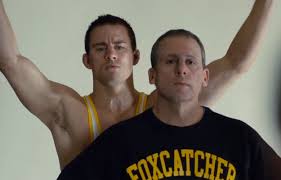
Steve Carrell is unrecognizable as the ghoulish DuPont. His performance is Oscar worthy. The palatial estate spreads out over hallowed ground near Valley Forge, where he fancied himself a patriot, a philanthropist and a great American person – everything his family history suggested he should be. But, DuPont was friendless, lonely, delusional and psychotic. He settled long ago for the appearance of greatness, having no foundation for the substance in himself.

Channing Tatum is the moody, self-doubting hulk of an athlete, Mark Schultz. The younger Schultz and his brother, Dave Schultz, played by Mark Ruffalo, grew up without a father. The movie is based on the story of Mark, who was largely raised by his brother, only 18 months older. He knew no privilege, but for the natural gift of athleticism that he had in spades. The Olympic gold medal he won, the pinnacle of athletic achievement, however, was not large enough to plug the gaping hole left by a childhood lacking in parental involvement and stability. Mark had wrestling; but he was alone and had nothing else.

Mark Ruffalo completes the trio of sure Oscar nominees as Dave Schultz. Ruffalo became the affable, elder Schultz, taking on his very mannerisms and demeanor. In reality, Dave Schultz was a student of the sport of wrestling; he was also teacher, mentor and coach, willing to help anyone, even his opponents. Dave had the things money could not buy, including a family. He was honored among his peers worldwide.  He was a virtual ambassador of the sport. Having learned Russian, he was welcomed as a star even in the cold war Soviet Union.

Dave Schultz was gregarious and humble. Only 18 months older than his brother, Dave was a father, brother, mentor, coach, ambassador to the world – he was a great man with real character. Dave Schultz is not the focus of the movie, however. The movie is the Mark Schultz story, and DuPont stars as the parasitic benefactor.

The Schultz brothers rose from the humblest background to world and Olympic champions. Dave Schultz lead the way on the strength of his character, work ethic, study of the sport, personality and relentless pursuit of excellence. Dave Schultz is the real thing, full of substance, honor, nobility, character and achievement that recognized by all.

Dave Schultz is everything John DuPont was not. DuPont was raised in privilege, but he was a wisp of the person he imagined himself to be. We see this in the scene in front of the prodigious trophy case in the generous den of the massive estate was filled with accolades of days gone by. They were trophies not earned by John DuPont. When two Foxcatcher wrestlers won world medals, DuPont had the biggest trophies moved from the case to make room for the two world medals that DuPont also did not earn – a metaphor for his sorry life.

The fact that the World medals were tiny in comparison to the over-sized trophies of thoroughbred horses is also telling. The horse trophies took on more significance in prominence and placement in the cavernous den of the DuPont manor than world medals earned mano-y-mano, through blood, sweat and strength of will in the honest struggle of men against men. The affected nobility of wealth and privilege is more highly valued than the substance and character out of which common men hue their destinies.

Mark Schultz was more affected by the absence of a father and unstable childhood than his brother, maybe, because he did not have to be the strong one. Only 18 years younger than his brother, he was highly dependent on him. He also lived in his shadow of the strength, character and personality of his brother. He thrived in connection with his brother, but he withered apart from him.

DuPont saw that weakness and attempted to exploit it. DuPont desperately wanted to be something, and his way to achieve what he wanted to be was to buy it. He saw the value in the unsung heroes that are wrestlers, and thought he could strap himself to the honorable and noble value of the World’s Oldest Sport like a man strapped to a rocket heading to the moon.

DuPont had never earned anything in his life. His life, position, money and name were all given to him. He had no friends. His accolades were manufactured. He found in Mark Schultz someone who was not adequate in himself, in spite of his achievements. The younger Schultz had nothing but wrestling, while his brother had moved on to family and mentoring others as a father, husband and coach.

DuPont found Mark willing to accept DuPont’s stilted patronage, but he could not thrive under DuPont’s shadowy tutelage. DuPont only fancied himself a coach, a great leader and a man of inspirational substance. DuPont scripted the relationship, but the doughy actor of the story concocted in his own mind could not produce in Mark Schultz the substance that he he desired to replicate.

Eventually, DuPont rejected the weakness in Mark Schultz, though he never seemed to recoil from the façade in which he hid his own weakness. Dave Schultz accepted an offer he could not refuse to give his family a stable environment, something he never experienced for himself growing up, but the affection of Dave Schultz could not be bought. The elder wrestling statesmen immediately took over the Foxcatcher room as easily as strolling into it. Leadership was in his gait and substance was in every word he spoke.

The natural strength and substance of Dave Schultz eclipsed the weak and shadowy DuPont. Schultz would not play the part DuPont wanted of him. He would not allow the shady affectations of DuPont interfere with the real business of training men, including his brother. If Schultz had a weakness, it was that he accepted the assignment for what it appeared: an opportunity to train world champions and provide for his family a stable home. Schultz was a man of substance among men of substance and could not identify with or understand the pretensions of the unstable, delusional mind of DuPont.

In the final scene of the movie, DuPont watches a tape of Mark Schultz giving a speech DuPont wrote for Mark to deliver extolling DuPont as a father figure, mentor and coach. None of it, of course was true. DuPont previously tried a different speech on for Dave Schultz to give, but the older Schultz could not do it – because he would not say what was clearly not true.

DuPont, however, could not accept the truth. As he had done his entire life, he played out the lie. Without any warning and few words, DuPont instructs a servant to drive him to the Schultz house on the compound where Schultz is working on his own car. Schultz greets DuPont, and DuPont shoots him without a word spoken.

In what some might say is the most ironic and poignant scene of the movie, DuPont’s mother refuses to allow him to place a medal DuPont won in an old timer wrestling tournament in the main trophy case. She also tells him, “Wrestling is a low sport. I don’t want to see you low.” Appearances and realities are two very different things.

It is also ironic that DuPont saw the value in the unsung heroics of wrestling, but he could not attain to it. True character and nobility in the movie is seen in the strong but tender Dave Schultz. Privilege and advantage could not give DuPont what he wanted most, but it gave him power –power that he used to buy a facsimile of that honor and nobility; and, when he could not purchase the words from Dave Schultz’s mouth, he simply eliminated Schultz like one of his mother’s thoroughbred horses.

Gruber Exposes What is Wrong with Politics

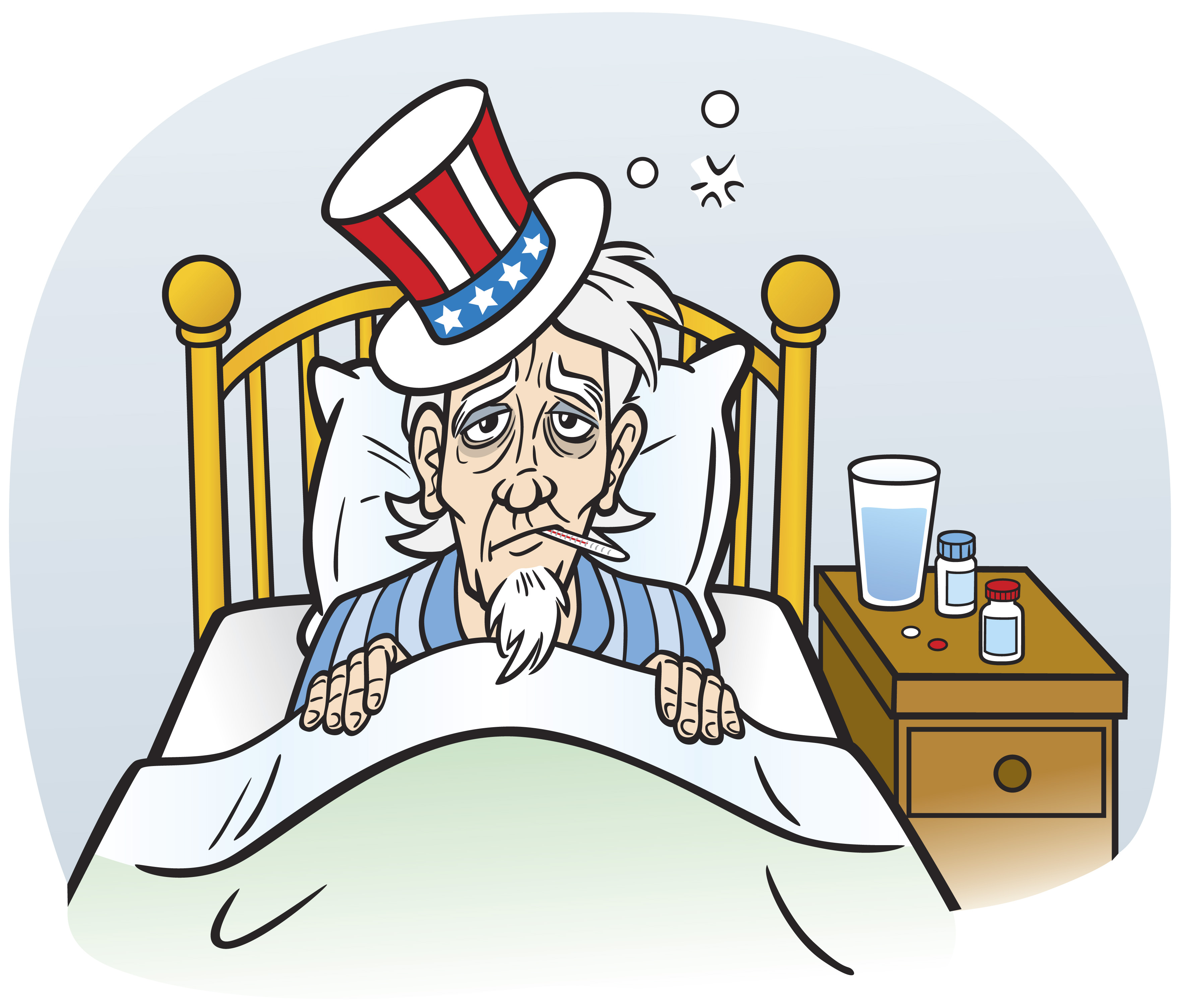
Uncle Sam Sick in BedJonathan Gruber, a previously little known MIT professor, has stumbled into the national limelight with statements about “stupid voters” and the intentional use of non-transparency in drafting and promoting the Affordable Care Act (ACA) so that voters would not realize what was in it.

Gruber candidly admitted the promoters of the law determined it would not have passed but for the non-transparency, quickly adding that it was important to keep the truth from the voters because the law was too important to risk not passing it.

Regardless of one’s view of “Obamacare”, our nation should be up in arms over the revelation that non-transparency was employed by design in the drafting of the law and in getting it passed. We should be outraged and offended at the notion that we are too stupid to understand and not to be entrusted with the a clear explanation. American citizens should be taking action to ensure that our nation’s law, which require transparency in government, are enforced at the highest levels.

One MSNBC blogger, however, called the “Jonathan Gruber mess” much to do about nothing. (MSNBC)

Champions of the ACA are scrambling to minimize the damage and downplay Jonathan Gruber’s role in writing the law and getting it passed.  Nancy Pelosi says she does not know who Jonathan Gruber is. (Washington Post) Nancy Pelosi responded soon after his remarks leaked out to the public that Jonathan Gruber was not involved in the drafting of the Affordable Care Act. Unfortunately for Pelosi, the Washington Post found a 2009 video in which she specifically cites Gruber’s work associated with the Act. (Washington Post) Sarah Kliff of left-leaning Vox.com, now says Gruber was “merely a number-cruncher”, though she previously said Jonathan Gruber “pretty much wrote Obamacare.” (the redstate.com)

Unsurprisingly, the real politicians are not as apt to be candid, as Jonathan Gruber was, about the facts.

Ironically, Nancy Pelosi’s 2009 comment cites Jonathan Gruber for the point that the ACA bill (then) will bring down the spiraling costs of health care. (Washington Post) Jonathan Gruber, himself, however, says that the ACA was never intended to bring the costs of health care down. In fact, he pointedly said it would not bring the costs of health care down; they just had to spin it that way because that is what the voters wanted to hear. (See the video of Gruber’s statement in the Washington Examiner) This is another variation on the “stupid voters” statement that has put Gruber in the public and Congressional cross-hairs.

The post remarks spin on Gruber is disingenuous and underscores the lack of honesty and transparency in our government at the highest level. Nothing is more disheartening to me than this utter lack of forthrightness in our federal government that appears to be fueled and justified by an elitist notion that “they know what is best for us” (so it does not matter how oblique they are with the American voters).

An article at reason.com shows just how disingenuous the backpedaling is. “These reactions from Obama and others were, for the most part, technically true—but nonetheless misleading about Gruber’s influence on the law. At a minimum, they were not fully transparent about his role.” This article lays out how intimately and completely Gruber was involved in both the drafting of the law and in selling it to the public.

The elitist idea that politicians know best and, therefore, are justified in obfuscating the facts in order to pass a law is dangerous thinking! It is fundamentally un-American. It is the primary reason that people are so skeptical and do not trust politicians; indeed, “politics” is a dirty word for reasons like the Gruber remarks.

It is not the remarks, per se, but what they reveal. The Gruber remarks epitomize all that is wrong with politics. He said in one of the videos that has been circulating around, “Lack of transparency is a huge political advantage.” The remark reveals an attitude that anything goes as long as we succeed. Succeeding in politics means advancing the party’s platform and (most importantly) staying in office at all costs. Transparency should be the unequivocal benchmark that is protected with non-partisan diligence, but it turns out it is merely a partisan tool to be discarded for a more expedient device.

In the congressional hearings, Gruber seems to be using “the stupid defense” to explain the statements that he made. (townhall.com) (He says they were glib and inappropriate; he says he was trying to make himself look smart on subjects (politics) about which he is ignorant.) I am disposed to believe he is just being dumb like a fox. It seems completely disingenuous.

On the other hand, maybe there is something different about Gruber (from professional politicians). Maybe there is some semblance of sincerity in his obsequious explanation for the “glib” and “inappropriate” remarks when he says, that he was not as smart as he thought he was and should not have tried to wade into the politics of the Act. Politicians would not be so glib (think candid). They are more practiced in the art of making appropriate remarks (think spin and cover up). Gruber’s forthright (albeit arrogant) admissions of the game plan for Obamacare would not come out of a practiced politician’s mouth.

In the same congressional hearing, Jonathan Gruber stated under oath that he was not the “architect” of Obamacare. (Fox News) Calling him the “architect” may or may not be an accurate description, but he was most certainly involved. Gruber may not have been “the” architect of Obamacare, but he spoke at length on the “detail we considered when we wrote the Law” at a presentation in 2012. (January 18, 2012 Speech) During the recent congressional hearing, Gruber refused to disclose how much money he made from his work on Obamacare. (thefiscaltimes.org (unofficial estimates are between $2 million and $5.9 million))

It appears that Gruber has learned a thing or two about politics since he made the candid remarks that got him trouble, and that is not a good thing.

I am afraid that the real problem with politics in this country will be lost in the partisan scramble to make hay out of the Gruber debacle. People will forget the exposure of the ugly underbelly of politics for all of the furor over health care issues. They will miss the forest for the trees. Health care is an important issue in this country, as Gruber even pointed out. We need to fix health care, but Gruber exposes a more fundamental, farther-reaching and indemic problem, and that is politics itself!

I am afraid that problem will be swept under the rug, by both sides. Gruber’s forthright statements about non-transparency are fodder for Republican opportunists, but they may only be useful for partisan purposes. They will be used to advance the conservative cause, but they are much too dangerous to be used for any other purpose. If Congress took the time to focus on the what is wrong with politics, they would all have to play dumb.

Poverty Level Support for Gold Medal Athletes

Facing Shoulder Surgey & 10 Months of Rehab

Facing Shoulder Surgey & 10 Months of Rehab

This is a sequel to Foxcatcher Previsisted, which was ostensibly about the Cannes award winning film showing in theaters currently about Olympic wrestlers, Mark Schultz and Dave Schultz, and their benefactor, millionaire, John DuPont, who killed one of them. The Foxcatcher piece was a pretense to highlight the sorry state of the “system” that supports Olympic athletes in this country (if you want to call it support). I now have more fuel for the fire.

How Well Are US Athletes Supported by the USOC? is the title of an article by the U.S. Athletic Trust. Not well it turns out. There would be national outrage about the revelations exposed by the U.S. Athletic Trust if more people had sons and daughters chasing Olympic dreams, but the numbers are small. These are the best of the best in their various fields of athletic prowess. The ranks are more elite than professional athletes who pull down multi-million dollar contracts annually.

I have listened to the banter on sports talk radio about the obscene salaries that professional athletes make, which are only outdone by the even more obscene money professional sports franchises make off of these athletes. Since the money is off of the athletes, as the rationale goes, the athletes should share in the wealth. It is only fair.

That same logic has recently prevailed at the college level when student athletes from Northwestern University took the NCAA to court and won the right be compensated. College football, in particular, is a cash cow for colleges and universities, and all the money is made on the backs of the athletes who cannot share in it. At least they could not share in it until now, it appears. That may be changing.

Even college athletes get something for their efforts, even if it has not been cash in their pockets. Various levels of scholarship pay for their education. The best college athletes also get to look forward to making the obscene professional money.

Not so with Olympic athletes. Many of them did enjoy college scholarships, if they participate in a sport for which college scholarships are available. Some Olympic sports do not have equivalent collegiate sports. Men’s freestyle and Greco wrestling, for instance, have no equivalent collegiate sport, unless you want to count collegiate folkstyle wrestling which is what many (but not all) of them compete in. After college, however, there is no pot of gold at the end of the rainbow.

If the rainbow is the Olympic Dream, the road is rocky and difficult, and the only gold one can hope to attain is a medal the size of a tiny pancake. It turns out a gold medal is hardly even made of gold. It is about 90% silver!

One might assume that athletes at the pinnacle of their sports would be well supported as they train year round for an Olympic opportunity that comes only once every four years, but one would be wrong.

In the U.S. Athletic Trust article, the numbers are shocking. I suppose they are not unlike what professional sports may have looked like before professional players’ unions. The International Olympic Committee (IOC) has $5 Billion revenue. The United States’ Olympic Committee (USOC) had a $795,917,076 budget in the years examined by the U.S. Trust (2009-2012). During that same time period, the direct expenses that supported the US athletes was $81,622,014.

Only a little over ten percent (10%) of the total USOC budget went directly to support the athletes! (According to the USOC) The Athletic Advisory Council (AAC), which did its own assessment, calculates the amount of direct athlete support from the USOC at only six percent (6%)!

It gets worse. Administrative expenses accounted for more of the funds than what the athletes received (14%). The Olympic Training Center costs were over double what the athletes received (23%). The big number, however, is the “US member support” at a whopping sixty five percent (65%)!

“Member support” means non-profit organizations for the various sports. Of those NGBs, the US Ski & Snowboard Association received the lion’s share (at $3.45 million), followed by USA Track & Field ($2.72 million), US Speedskating ($2.52 million), USA Swimming ($2.49 million) and US Shooting ($1.75). A total of 17 non-profits associations received over $1 million grants each and 37 other non-profits received less than $1 million grants.

Each of those organizations have similar structures to the USOC, in the sense that they are top heavy, with only a small percentage of the revenue trickling down to the athletes. USA Wrestling, for instance, received about $1.5 million form the the USOC and passed about $250,000 on to the athletes directly. That is about the salary for one USOC leader or two USA Wrestling leaders. According to the U.S. Athletic Trust article:

Most athlete stipends, which are reserved for only the top ranked athletes, are in the $400 to $2,000 per month range. Or $4,800 to $24,000 per year, which is below minimum wage for many considering how many hours go into training for the Olympics.  And those are the fortunate ones to even receive stipends.

The very best, the number one person at each weight, receives a poverty level stipend each year. That would include gold medalist and, arguably, the best wrestler in the world, Jordan Burroughs.

In wrestling, only the “world team members” receive a stipend. That means three (3) deep at each of the six (6) weight classes for men’s freestyle, women’s freestyle and men’s Greco – a total of 54 four athletes! To put that in perspective, the total number of wrestlers registered with USA Wrestling for the 2012-2013 year was 176,249. (teamusa.org/USA-Wrestling) Those wrestlers competed for 4153 clubs chartered with USA Wrestling. Only the best 18 wrestlers in the country receive the maximum stipend of $24,000 a year!

Only a small number of wrestlers last more than one Olympic cycle. They drop out, not because their bodies give out, but because their wallets give out.

Maybe all of this would be fine if there was a way to make a living (other than as an USOC or USA Wrestling administrator) from wrestling. I have focused on wrestling only because my kids wrestled. I saw how this all shakes out first hand as I watched my son struggle his way up the Olympic ladder. That climb came to an end as a result of injuries, the surgeries for which I and my health insurance paid.  At the age of 26, he is starting from scratch, while his classmates are well into their careers.

If professional sports leagues were run this way, there would be an uproar. The entire $795 Million budget of the USOC is made on the backs of the most elite athletes in their various sports this country has to offer. It seems everyone gets their cut except for the athletes!  Precious little goes to the athletes, and the funds that do trickle their way down are so diluted that it hardly provides a poverty level sustenance for the very best of the best.

The U.S. Athletic Trust article is bound to be an eye opener for most people. It is all too familiar for me. If you feel that the lack of support for our Olympic level athletes is not fair in light of how we compensate professional and even college athletes in our society, please weigh in with your opinion. Leave a comment. Donate to the U.S. Athletic Trust. Let others know, and help raise the awareness of your friends and neighbors.

If you are interested to know more, here a few more eye opening pieces that reveal the miserly lack of support our US Olympic athletes receive.

 “The Intrinsic Value of Elite Athletes.”

How Olympians’ families have gone broke by supporting their children.

The jobs that Olympians have held while competing, from nurse to janitor.

The actual costs of being an Olympic athlete; costs which are borne by the athletes and their families, and not the USOC.

Foxcatcher Pre-Visited

SONY-FXOS-03_102414_SteveCenter_FINAL.inddI cannot title this piece “Foxcatcher Revisited” because I have not seen it yet. I have read a lot about the movie. I know the story. I know one of the wrestlers who was there, on the estate, when the shooting happened. I have talked to him on several occasions about the details.

I am also a wrestler. Once a wrestler, always a wrestler. All five of my boys wrestled at some point. Two of them were state placers and All-Americans. One of them wrestled at the Olympic level. I know wrestling.

If you know wrestling, you know the Foxcatcher story. I do not necessarily mean that you know the movie story; you know the story behind the story.

The story behind the story is that wrestling, the world’s oldest sport, a sport of character and real life heroes, is under appreciated, relatively unknown and misunderstood, existing in the shadows of more popular and popularized sports. Wrestling is like the orphan or the widow of the sports world. It is fitting then, that one of wrestling’s true heroes, Mark Schultz, grew up fatherless with his brother, Dave Schultz, who are the protagonists in this Cannes award winning production.

Actually, Dave Schultz is the hero. He was a father figure to his 18 month younger brother. He was the face of wrestling in the US, like Dan Gable was in the previous generation. He was an ambassador of wrestling, receiving a hero’s welcome in foreign countries like a dignitary. He was better known in the Soviet Union and Iran than in his own country.

Unlike wrestling in those countries, there is minimal support for wrestling in this nation of overabundance and wealth. In the Foxcatcher days, Olympic athletes were still required to be amateurs, which was really a joke considering how foreign athletes were completely supported by their governments. For US wrestlers, it meant they had to live like beggars.

In that atmosphere, a pasty white, doughy, junkie, reclusive millionaire with bizarre, egocentric delusions of grandeur seemed like a savior. I am describing John DuPont, of course. He is the real life antagonist in the Foxcatcher movie. The Olympic athletes, including, perhaps, the greatest wrestler of his generation, had to put up with the egomaniacal paternalism of John DuPont, who would be despised in the company of street urchins, as the price for continuing to follow their Olympic dreams. The other option was living at the poverty level. They had all done that already.

This movie really hits home for the amateur wrestling world because nothing much has changed. While the average baseball, football or basketball player makes millions of dollars as rookies, most of the very best wrestlers this country has to offer live at the poverty level. Olympians are no longer constrained by the ruse of “amateur” status, but that only makes the present reality a more biting irony.

Only one wrestler at each of the six (yes only six!) Olympic weight classes can represent the country. World cups in the off Olympic years offer a generous eight spots. Three wrestlers at each weight are considered the “world team” and are supported by USA Wrestling. By supported, I mean they get a stipend of $5000 to $15.000…. a year.

Of course, they can live for free at the US Olympic Center in Colorado Springs, but most of them do not (and that is another story). Those same World Team Members and some select others may be sponsored by The New York Athletic Club or Sunkist Kids Wrestling Club. That might add another $3000-$5000 to the coffers and get tournament entry fees, plane tickets and hotels paid. Other clubs come and go, but there are never enough sponsorships to go around.

My son tore a tendon in his shoulder off the bone right after he was offered to be sponsored by Sunkist. There was no sponsorship after that. I had to pay for the surgery to put in a cadaver tendon and the ten (10) months of rehab. That was the first of two major shoulder surgeries along with the plane tickets and hotels I paid for.

In off Olympic years, a world gold medal will earn $50,000 from the Living the Dream Medal Fund, a world silver medal nets $25,000, and a world bronze medal gets a robust $15,000. A WORLD bronze medal provides a poverty level income for a family of two. (US Dept. of Health & Human Services) In Olympic years, an Olympic bronze medal will generate a $25,000 prize, silver a $50,000 reward, and an Olympic Gold Medal is rewarded with $250,000 – all from a fund that has been created by wrestlers through donations provided by wrestlers. There is no other support.

The Foxcatcher movie, in my opinion, is about the sorry state of support for the sport of wrestling in our country. Olympic gold medal winners cannot support themselves and their families without begging for scraps from benefactors. The NYAC and Sunkist are benefactors. John DuPont was a benefactor – a schizophrenic, delusional, homicidal benefactor.

If Olympic wrestlers have to stoop so low to have the opportunity to be the best in the world, what about the number 2 and number 3 guys at those weights? What about the five other number 1 guys at the other weights who are not quite THE BEST IN THE WORLD? Maybe they are 5th best, or 7th or 15th best.  What about the guys, like my son, who spent six years climbing the Olympic ladder and maybe just breaking into the top ten in the country before injury ground that climb to a halt? Or maybe the money runs out, or the grind of working harder everyday than most people have ever trained on their best day for little reward just gets old.

Pasty white lunatics start looking like gods from certain angles. That is what Foxcatcher is about. I have not even seen it yet, but I will.

The Movie has been acclaimed. The actors, Steve Carrell, Channing Tatum, Mark Ruffalo and others, give award winning performances. A comparison of the real life facts and people to the movie shows how “real” and true to life the movie is. (History Hollywood) For a wrestler’s critique of the movie, see this Forbes article.

There have been many articles and reviews. Many of them focus on the exemplary acting and hauntingly real portrayals of the characters. Many of the facts are changed and condensed, but they reveal the essence of what happened. I have read reviews finding supposed political messages and squeezing social commentary from story pulp, but to me it is simply a sad story about the sport I love – the sport that saved me from myself and that has built real character into innumerable lives of men – and women –who need real heroes to inspire them.