The Perspective of Attitude

Icy Iron Gate - Copy

[E]everything can be taken from a man but one thing: the last of human freedom is to choose one’s attitude in any given set of circumstances — to choose one’s own way.

The only thing more uplifting for me today than the sun shining, the birds chirping and the realization that the worst of winter is behind us is Kristen Ziman’s article, “Bad Attitudes and Glowworms”, in the Aurora Beacon News on March 25, 2014. Mind you, Kristen is an Aurora Police Commander. She sees the worst of humanity on a daily basis. The quotation at the top of the page is from Viktor Frankl, a holocaust survivor. Those connections should strike a chord.

If you are like me, you like to be in control. I feel most comfortable when I am in control (even when I have no good reason to feel comfortable based on my past failures). People seem to tolerate even bad situations better when they feel like they have some control. Conversely, feeling that we lack control tends to leave us feeling depressed and out of sorts.

We make decisions and choose to go this way or that way. We make plans and carry out our plans the best that we can. Some of us are better at planning and carrying out plans than others, but even the best planners among us find that things happen that frustrate, change and redirect the paths that we have chosen. Things happen every day, even hourly, that we did not plan or expect when we awoke in the morning. When things do not go as planned, the tendency is to get frustrated, angry, disappointed and even depressed.

It occurs to me that control over our lives ultimately is just an illusion. A parent dies unexpectedly, a person gets laid off, a plane gets hijacked, a mudslide happens, the dream of becoming a professional baseball player does not pan out, the college we want to get into does not accept us, we can not find a job in our field of study. There are a million things in our lives that we do not control.

We did not choose to be born. We did not choose the time we were born or the country or family we were born into. We did not choose our genes, physical attributes or psychological make up.  We do not inevitably control our lives, and we all will die.

When you think about these things, it may seem depressing, but it is all a matter of attitude.

Perhaps, the only thing I do truly control is my attitude, my outlook on life, my world view (whatever you want to call it). As the Frankl quotation suggests, if all control is taken away from me, I still control my attitude. I may not control my circumstances, but I control my response to those circumstances. I can “choose my own way”. Though there is no guaranty I will be able to carry out the way I have chosen, I am able to choose nonetheless.

We all live in the illusion that we control our own lives. For some of us that illusion seems more real than for others, but none of us truly control our lives.

What if that is the way it is designed? What if attitude, including my relationship with people, is the only thing I am meant to control?

********************************************************

Ironic post script: I was first inspired to write about attitude and outlook on life. I quickly got off track with the idea of control (or the lack thereof). I followed the track and ended up someplace I did not envision when I started. I kind of like that in this instance, though my tendency is to go back and direct my attention back to where I started. I chose to let it go a different direction. Kristen Ziman’s article is good one. I encourage you to go back and read it if you have not done so.


The Media and the Genie in the Bottle

Question MarksIt has long been the cry from the Right that “the media” has a liberal bias. Recently, Sharyl Attkisson just resigned from her two decades long stint with CBS citing “liberal bias” as the culprit. (See Sharyl Attkisson resigns from CBS News as reported by Politico Magazine online.)

For grins I searched the following sites in vain for any word about the resignation of the long time CBS reporter: Nothing on CNN, NPR not even on CBSNews. Not surprisingly, I did find plenty on Fox News, including a tweet by Britt Hume: “The liberal culture of the major networks news division claims a scalp.” This was in response to Sharyl Atkisson’s tweet: “I have resigned from CBS.” The lack of any word in the “liberal” media sources, and the corresponding coverage by the main “conservative” media source seems to underscore the notion that media is biased in America.

Is it really any surprise? Gallup polls over the last decade plus report the common perception that the media is biased. (Media Research Center)  The perception is overwhelmingly that the bias is liberal. Over those years, the ratio of people who think the media is too liberal to people who think the media is too conservative has ranged from over 2 to 1 to over 4 to 1.

I am not noting anything new of course, though it does depend on who is asked. Over the same period of time, there were people who reflected the thought that the media is too conservative, but the numbers range from 11% to 19% of those polled; while a consistent 44% to 48% hold that the media is too liberal. The “too conservative” group is comprised primarily of those labeling themselves Democrats and liberals. The “too liberal” crowd is overwhelmingly the Republican and conservative group. (Gallup)

Can there be any doubt that our perspectives and our positions depend on where we stand?

It seems that the collective “we” used to maintain the pretense that reporters and news agencies are unbiased. Sure, journalism schools preached the party line. People, however, are not unbiased; and, frankly, I doubt reporters ever really were unbiased. People are people in whatever era they live, and people have biases. In years gone by, reporters and news agencies may have made more of a concerted effort to maintain the ideal, but the ideal is certainly more of an illusion than reality.

I have rued the “loss” of the unbiased media ideal in a reflexive sort of way myself. Some honest reflection on the other hand leads me to wonder why I/we ever bought into the notion that people can be unbiased at the core.

More of a concern is the loss of trust in reporting. Gallup has chronicled that growing distrust over the last decade. In the last seven years, less than half the people polled trust in the media, and well over half the people polled trust the “not very much” or not at all. (See Gallup)

Interestingly, Democrats responded that they trust the media in high numbers – no lower than 59% and as high as 70%. That stat, alone, affirms the media has a liberal bias. Republicans report little trust in the media –never above 49% and as low as 25%. Independents, too, have comparatively little trust in the media, though ranging higher than Republicans – topping out at 53% and falling to 31%. (See Gallup)

In my own interactions I have heard visceral reactions expressed by conservatives to liberal media outlets and just as visceral reactions to Fox News. Let ‘s face it: Fox News is the only major media outlet that leans the other way. Each side of the spectrum dismisses the other the opposite media source ab initio. That, to me, is more troubling than the false notion that media is objective or the resigned realization that it is not objective.

We all stand somewhere on the spectrum, and we calculate the world from that reference point. Pretending we do not is dishonest. Pretending the “the media” does not do that is dishonest. Unbiased reporting was once held out as a professional standard. Appearances were kept up to pretend it was observed. In this day of the Internet, we can no longer give any credence to that illusion. The genie is out of the bottle. Was it ever in the bottle to begin with.

We should really stop the pretense that media is (or can be) unbiased. We should stop the surprise and indignation. “The media” are people, and people have biases! I dare say we should all spend some time entertaining “the other side” of the spectrum from us. I doubt it will change any of our minds, but it will help us understand each other a little better.

Youth Sports from the Rear View Mirror

Young Nicholas WinI read a short, but very insightful, article on youth sports that strikes me as very good advice after six children of my own and 22 years of coaching them and other kids. You can read the article here: The Only Six Words Parents Need to Say to their Kids about Sports.

It is very simple, but many people “get it wrong”. I include myself in that statement. It took me much of those 22 years for me to learn what is important with kids and sports. I might finally understand.

Like the article says, team and individual sports can be tremendous character builders, instilling lifelong lessons like team work, dealing with winning and losing, overcoming fears and anxieties, leadership, sacrifice, discipline, hard work, goal setting and many, many more things. The problem is that parents, and coaches, sometimes do more damage than good and sometimes negate the lessons that are there to be learned.

I feel like I need to let parents in on a little, nasty secret. Not every kid is going to be a superstar. The six year old “stars” are not necessarily the twelve year old stars or the high school varsity stars. In fact, there really are not that many stars. Even the stars are not always going to shine. The star little leaguer or varsity player in Everytown, USA is probably not going to be a scholarship athlete, let alone a professional athlete. (Do not tell them though! They will figure it out soon enough.)

The percentages are infinitesimally small the number athletes who get athletic scholarships for college and infinitesimally smaller yet the number of athletes who will make a living at any professional athletic level.

Let your kids be kids and be satisfied that they have fun, work hard and develop some life lessons along the way. In fact, if they do not have fun, do not work hard and do not pick up any character from youth sports, they are missing the best part!

Winning and losing are their own proving grounds without much help from you. Not everyone gets a medal. There are clear winners and losers. Kids know that. Emphasize the fun, the benefits of working hard and the nuggets of character building lessons, and the rest will take care of itself.

One of my favorite stories, one of the times I think I got it right, was when my 20 year old was about 10 or 11. He wrestled and was pretty good, but one opponent “had his number”. They met up at the kids regional qualifier for state for a place match. It was a battle. The other kid led most of the match, but my son fought hard and tied it up in the last seconds of the third period. In overtime, it was scoreless until the very end, when the other kid managed a takedown to win it.

Both kids literally fell over from exhaustion, completely spent! They both lay there, unable to get up, even after the referee, impatiently wanting to move on after a long day, told them to “Get up!” They had both used every last ounce of strength and stamina and could not move.

I told my son how proud I was when the impact of another loss showed on his face afterwards. I pointed out that he “left it all on the mat”, and the other kid did too, and that is all anyone could ask. I reminded him of that match often, and I still do, and he always smiles.

The Dream That Lives On

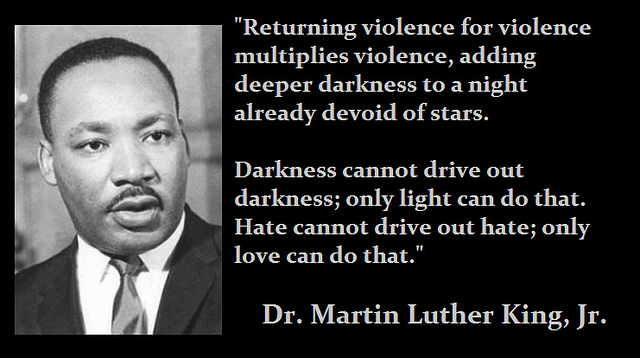
Paulsasleepwalker- MLK-Nonviolence


I am not black and cannot imagine what it feels like to experience the dark side of discrimination. I don’t understand what it feels like, but I do believe we need to get past discrimination – of any kind. I yearn for the day when we can agree or disagree on something, and that something has nothing to do with the color of anyone’s skin.

I will never forget the day Dr. Martin Luther King, Jr. died, a day that has affected the rest of my life. I remember the shame of a young classmate expressing prejudice, and I knew instinctively that prejudice was wrong. I was very young – only 8 – when he died, but I still recall that next April morning, walking to grade school in the bright sunlight. The brightness of the sun was in stark contract to the dark emptiness I felt for Dr. King’s death and the hatred that caused it. Continue reading

Who is More Charitable?

charity road sign arrowAs I was driving home from the office tonight, a conversation on NPR got me thinking. The participants in the discussion clearly assumed that conservatives are less generous than liberals. They recited the reasons why conservatives opposed certain legislative initiatives as if they had the blue print to the conservative mind and heart…. , but did they?

I decided to research the matter as best I could. This is what I found:

The first thing I found was from the Democratic Underground. Based on a study done in 2008 by the Internal Revenue Service of taxpayers throughout the country, The Chronicle of Philanthropy reported, “The eight states where residents gave the highest share of income to charity went for John McCain in 2008. The seven-lowest ranking states supported Barack Obama.” The middle class earners (making $50,000-$75,000) were more generous than those making more than $100,000. The more deeply religious areas of the country were more generous than the less religious areas of the country.

George Will, of course, cites the Brooks Study. He points out that Brooks is a self-labelled independent and was surprised by the data, so surprised that he initially thought it was faulty. Among the findings were these: 1) “Although liberal families’ incomes average 6 percent higher than those of conservative families, conservative-headed households give, on average, 30 percent more to charity than the average liberal-headed household ($1,600 per year vs. $1,227)”; 2) “Bush carried 24 of the 25 states where charitable giving was above average”; 3) “People who reject the idea that “government has a responsibility to reduce income inequality” give an average of four times more than people who accept that proposition”; 4) “America is largely divided between religious givers and secular nongivers, and the former are disproportionately conservative. One demonstration that religion is a strong determinant of charitable behavior is that the least charitable cohort is a relatively small one — secular conservatives”; 5) Democrats represent a majority of the wealthiest congressional districts, and half of America’s richest households live in states where both senators are Democrats”; 6) “Vice President Al Gore’s charitable contributions, as a percentage of his income, were below the national average: He gave 0.2 percent of his family income, one-seventh of the average for donating households. But Gore “gave at the office.” By using public office to give other peoples’ money to government programs, he was being charitable, as liberals increasingly, and conveniently, understand that word.”

From the freerepublic.com citing John Stossel – all but one of the top 25 charitable states voted Republican in the 2004 election; and Stossel noted, “Conservatives are even 18 percent more likely to give blood.” Quoting  Professor Arthur Brooks of Syracuse University, author of the 2007 book Who Really Cares, “When you look at the data, it turns out that conservatives give about 30 percent more. And incidentally, conservative-headed families make slightly less money; “and people who believe it’s the government’s job to make incomes more equal, are far less likely to give their money away.”

From the New York Times, in an article by self-described liberal, Nicholas D. Kristoff, he says, “Liberals show tremendous compassion in pushing for generous government spending to help the neediest people at home and abroad. Yet when it comes to individual contributions to charitable causes, liberals are cheapskates.” A Google study revealed that conservatives give almost double what liberals give in proportion to their income. Kristoff says, “It’s true that religion is the essential reason conservatives give more, and religious liberals are as generous as religious conservatives. Among the stingiest of the stingy are secular conservatives”; and “if measuring by the percentage of income given, conservatives are more generous than liberals even to secular causes.” And another bomb: “liberal donations frequently sustain art museums, symphonies, schools and universities that cater to the well-off. (It’s great to support the arts and education, but they’re not the same as charity for the needy. And some research suggests that donations to education actually increase inequality because they go mostly to elite institutions attended by the wealthy.)” Finally, “People in red states are considerably more likely to volunteer for good causes, and conservatives give blood more often. If liberals and moderates gave blood as often as conservatives, Mr. Brooks said, the American blood supply would increase by 45 percent.”

In going through two pages of responses to my query on Google (who gives more to charity, Democrats or Republicans), I begin to come across commentaries on the same studies over and over. So I stopped. There were some pieces calling the studies into question, suggesting reasons for the differences, observing that religious people tend to give to churches and secular people tend to consider their tax money their giving and noting studies by several universities suggesting that the purpose for the giving triggers more giving alternately for conservatives or liberals, depending on the expressed purpose.

In the end, and without doing any independent research, it seems that Republicans, and conservatives, especially religious conservatives, give more to charity – though religious liberals are also liberal in their giving; while secular conservatives are the least charitable. According to the assumptions clearly couched in the discussion I heard, one would think that all Republicans are secular conservatives; but secular conservatives also had the smallest numbers of the groups studied.  I have no way of confirming the data independently, but I am satisfied, at least, that the assumptions were incorrect. Republicans/conservatives are not less charitable than Democrats/liberals (thought they may be much less adept in conveying their charitable inclinations, or at least are less public about their charity); if anything they are more charitable.

The Freedom In Defying Stereotypes

via The Daily Caller  by Ginni Thomas

via The Daily Caller
by Ginni Thomas

One thing that is a constant theme for me, something that is always just beneath the surface of my thinking, one that is continually rising to the top, is the truth that people are not stereotypes. I am probably as guilty as anyone of stereotyping. Sometimes stereotyping is useful, but we must never forget that people are not stereotypes.  Stereotyping people into groups, and stereotyping groups themselves, can be an impediment to truth, real dialogue and effective communication and understanding.

Sometimes, we even allow ourselves to fit into stereotypes by not thinking or acting independently apart from the collective.

It seems to me that some stereotypes are more “popular” than others at different times in our societal history, and that our history has been a series of societal movements to break those stereotypes. Race, gender, sexual orientation and many other categories of people and groups that have been stereotyped have gone through a collective metamorphosis. Currently popular stereotypes are of “homophobes”, Christians, conservatives, the news media and, yes, liberals too.

There was a time in our history in which African Americans were stereotyped and, therefore, categorized, segmented and dismissed by society as a whole. People thought ignorantly that blacks were inferior. Brave black men and women, who were highly intelligent and motivated, dared to show this stereotype was not true. The broke the stereotype by becoming educated and succeeding, in spite of all the obstacles.

The problem with stereotyping on a personal level is that it creates barriers between people. On a societal level, when stereotyping takes hold in popular culture, it creates barriers between people and people groups and segments of society. Those barriers have political, cultural, social and economic consequences. They feed and perpetuate biases and prejudices. We buy into to those thought patterns of others and even ourselves sometimes without realizing it.

Stereotypes can be insidious, and calling them out subjects them to scrutiny and diffuses them.  When stereotypes form unseen and prevail, they can be destructive. When stereotyping becomes so prevalent as to rise to the level of national (or popular) consciousness and begin to receive scrutiny, they inevitably begin to break down. When we become conscious of the stereotypes that inform modern, popular culture, we begin to see people stand out who do not fit the pattern. These are the brave pioneers who dare to be different, who purpose not to be defined by the categories others make for them. In this way, they and others who recognize them begin to break the patterns and encourage others to have the same freedom

This can be along, slow process when stereotypes become ingrained. Stereotyping of African Americans continued long after slaves were freed and civil rights passed and vestiges continue to persist today. I am struck, however, by the notion that stereotypes evolve. They come and go. In a weird way, “popular” stereotypes become opportunities for real change once they are recognized. .

In present culture, one of those stereotypes is that minorities are all liberals. Minorities who are not liberal are treated as rebels, outcasts, traitors. They are shunned by the “group” that claims them and demands they step in line. This is stereotyping. Stereotyping does not account for the fact that people are individuals and are not defined by the common expectations others have for them.

I was led there by a post on Facebook of a piece on a black, female professor taking issue with current Democratic politics. (Available here if you are curious.) It seems there is a rising tide of educated, black conservatives who are breaking down the stereotype that the Democratic party is the minority party. I think this is a good and healthy change. Racism is an extreme example of stereotyping. The very idea that all people of color should affiliate with one political party is stereotyping; in fact it is racism – it perpetuates the idea that all people of one race are the same, think the same, act the same and can be defined in the same way.

Stereotyping can be a way of categorizing and dismissing, but exposing stereotypes can be a catalyst for societal change. As people visibly break the stereotypical molds, change occurs. Real change does not come from legislation or demagoguery; real change comes from people stepping out boldly and daring to be different. Real changes comes from people who defy stereotypes and show the way for others to unchain themselves and embrace the freedom to define themselves.