A Long Slow Divorce: My Sports Journey

Tanner & JonathanWhen I was a kid, I was a true sports fan. Sports was a central theme of family get-togethers. We watched whatever seasonal sport was showing, and discussions at family gatherings always drifted to sports. The thrill of victory and agony of defeat ran through my veins and informed my dreams.

I read books from the 50’s and 60’s of improbable feats of heroism by ordinary athletes and teams. I religiously watched the Cubs, Bears and Blackhawks play on television and listened on radio. I swung a baseball bat for hours alone perfecting my swing and pitched tennis balls endlessly against a garage or brick wall with visions of a major league career running through my head. I galloped through backyard football games with a ball tucked under my arm like the ghost of Gale Sayers, replaying in my mind each night the highlight reel of my performance. My brother and I even played makeup hockey, baseball and football  games with any objects we could find for pucks, sticks, bats and balls – just the two of us.

Some of my earliest sports memories were watching the “Galloping Ghost”, Gale Sayers, run the Wrigley Field gridiron and Ernie Banks, Ron Santo and Billy Williams launch home runs from that same hallowed ground transformed to a diamond. Other icons of my early memories included Bobby Hull, Stan Makita and Tony Esposito, who brought Chicago as close to sports nirvana as my beloved Cubs.

The allure of the world of sports, however, began to unravel not long thereafter. When Wertz terminated the Blackhawks contract with WGN, relegating hockey to the snowy underworld of UHF TV, I was probably 9 or 10. I lost my taste for hockey and never regained it.  I was too young yet to appreciate fully why the Bears home games were not televised. I was very much cognizant; however, of the betrayal I felt when my beloved Cubs traded away Bill Matlock after he won the National League batting crown. The beginning of sports free agency did much damage to my preteen sports psyche. My heroes were not supposed to be traded away like commodities. Worse, they were not supposed abandon my loyalty to the Cubbie Blue. Ken Holtzman, Ron Santo and others followed.

Around the same time, I was introduced to a new sport. The 1972 Olympics in Munich featured what may be the most renowned American freestyle wrestling team our country has known, led by the inimitable Dan Gable. He was a different breed. He won gold without a single point scored against him and was the heart of that Olympic team that took home a many medals.

I became a wrestler that year as a 7th grader. Wrestling was a different kind of sports experience. People did not talk about wrestling. While other sports were all about the communal glory and acclaim of victory, wrestling was grind-it-out hard; no one knew much about it or talked about it; and the victories to be won were as much about overcoming doubts and fears in the heart as about prevailing in competition.

Most teenage boys inevitably find other things that are more alluring than sports as hormones kick in. I was no different. I ran track, played football and baseball, and I wrestled through my teen years, though other things captured my heart. I also abandoning one by one the sports of my youth until only wrestling remained. I carried wrestling into college where academics and other things took on more importance. The ideal of sports gave way to other ideals: the pursuit of knowledge, faith, and a soulmate, among others.

Though it is common for other things to take center stage as life goes on, sports remain a common denominator and topic of discussion and debate for most. It is part of our culture. Sports performances can be ennobling. Who does not remember the inspired performance of the 1980 Olympic Hockey team’s win over the Soviet Union? Michael Jordan’s ability to carry the Bulls to victory on his shoulders and to hit that last jump shot at the buzzer to synch the victory is the stuff of legend. But the luster had long begun to fade for me as I hit adulthood.

It turns out Michael Jordan was human. He gambled. He had a midlife sports crisis. He got divorced. Baseball, football and hockey strikes and lock outs each took their toll. Money has become the heart and soul of professional sports in a way that was not true, or at least not evident, when I was young. Money is a common theme that runs through professional sports, obscene amounts of it. Money dominates talk of college football and college basketball (all wanting a piece of the golden pie). Money, too, it turns out, runs through the veins of the Olympic movement, which seems to have stalled in the sludge of creeping commercialism.

The Olympic ideal began to tarnish with Communist regimes fashioning state sponsored, hand-picked athletes into finally tuned and performance enhanced machines. The fiction of amateur status could not be maintained. The victory of the US hockey team in 1980 was all the more legendary for the fact that the team was amateur David taking on the Soviet Goliath supported by the state. Now any professional can play in the Olympics. The professionals have not only tarnished the shiny Olympic finish, they have cheapened the games. Basketball in the Olympics is just a side show for the NBA. Perhaps the last nail in the coffin for me was the recommendation of the International Olympic Committee to remove wrestling from the Olympics.

For better or worse, money has not tainted wrestling, at least not at its core. There is no money in it.

I do not watch professional sports – at all – anymore. I have not watched a full baseball, football, hockey or basketball game in years with rare exception. I do not go to professional sports events. I have a hard time seeing  past the taint of money and the betrayal of the ideal that once illuminated a young heart and soul.

My sports heroes are, now, my sons who wrestle and their (my) fellow wrestlers. They and their fellow wrestlers (men and women) have my admiration and respect and remind me of what is good and wholesome and inspiring in sports. The hard work and dedication is unparalleled. There is no fame or fortune awaiting them. They do it only for the thrill of victory. They forge their character in the agony of defeat and the countless hours, the blood and the sweat, the focus and commitment it takes to overcome fears, doubts, temptations to take an easier road and all of the obstacles that life can bring to gain the ultimate prize of being, simply, the best of the best.

The glory and acclaim in wrestling is no less communal than professional sports, but it is a small community – more like a sisterhood and brotherhood. It is more like family than community, and it is, perhaps therefore, a stronger tie.

My 24 year old announced in December 2013, after 15+ years of wrestling that he was done. He spent the previous 5 years chasing the Olympic dream, coming within sight of it, yet being just out of its grasp. The injuries demanded their price. The sacrifices no longer made sense. It was not the way he or I hoped it would come to an end, but there is a season for everything under the sun. That season is now over. The journey built deep character and will be cherished.

Just months ago the elite executive board of the International Olympic Committee announced its recommendation to drop wrestling from the Olympics beginning in 2020. It came like a slap in the face. What could be more Olympic  than wrestling? What is more characteristic of the Olympic ideal than the World’s oldest sport? It was not only one of five sports in the ancient Olympics, wrestling was considered chief among them. It was at the foundation of the modern Olympic movement.

The IOC reported through a spokesman that they want to look to the future. Wrestling does not have television appeal.

The IOC seems to want fads, not ideals. Wrestling is apparently is not “sexy” enough, but sexy wears off. True love is not sexy. Ideals do not become obsolete.

For now, wrestling is back in the Olympics. The full IOC voted in September to reinstate wrestling as an Olympic sport. I fear, however, that the future of the Olympics will only be about money, TV ratings and trendy things. The IOC committee recommendation to eliminate wrestling is an omen. We have seen the future, and I do not like it.

The love of sports for me has been a long slow divorce. I will never watch another Olympics without wrestling. For now there is reconciliation, but I fear the Olympics will go the way of hockey and other professional sports have gone for me. I hope that wrestling survives; but if wrestling does not survive, the divorce will be complete.

Tragic Irony and A Newtown Example

Heinz Kluetmeier for Sports Illustrated

Heinz Kluetmeier for Sports Illustrated

We are too often reminded of the evil that lurks in the human heart, yet we react in shock whenever and wherever it erupts. The examples are the favorite children of the media, the fertile ground for growing readership. We recoil from senseless acts of depravity almost as much as we stop and stare at these train wrecks that are memorialized before us and etched into our collective minds by print and other forms of media. We fixate on them and exorcise them by appropriate judgment and disdain for the insensibility of deranged souls that star in these real life dramas, but these tragedies and our reactions to them also reveal some ironic human tendencies.

We are often not moved to great acts of goodness, except in reaction to tragedies. The more exposure to tragedies, difficulties and hardships, especially ones that do not affect us, the less likely we are to be moved by them to help others. When tragedy hits too close to home, we can be crippled into inaction; while the same tragedy experienced from a greater distance inspires others to action.

Fortunately, for most of us, tragedies happen to “other people” and rarely hit close to our homes. Perhaps unfortunately for those of us so lucky to avoid the direct fall out of a tragedy, the shock waves quickly dissipate as we go on with our daily lives. Not many of us are able to shake off the sleep that sets in with daily routines in a way that affects any change. The emotion fades quickly to a factual memory, stored away with historical dates and numbers and other tidbits.

I dare say that we tend to remain largely unaffected by distant tragedies after the initial  shock wears quickly off.

People are a funny lot. When things happen to others, we are not nearly so affected as when they happen to us, or close to us. When tragedy hits close to home, we tend to be deeply affected, and often deeply changed. The people who have been personally affected by tragedy, difficulty or hardship are the ones who devote themselves to helping others with similar experiences. Charitable organizations are often founded by people affected by the particular issues that the charities are formed to address. In this way, some people reap the fortune of other people’s tragedies.

Almost every tragedy, whether it comes from human action, natural events or other ways, triggers an outpouring of generosity, kindness, good will and even heroism. The Sandy Hook shooting, 9/11 and many other human tragedies are followed by these outpourings of good. It occurs to me that this phenomenon is kind of like Newton’s Third Law of physics (every action has an equal and opposite reaction). For every evil that occurs, people are inspired to react with great goodness.

There is certainly some irony in that. I am not sure why tragedies bring out the best in people. Maybe we are too easily dulled by everyday life into forgetting that people are in need all around us. It takes a catastrophic event, and clear evidence of need, to spur us to good actions. We are shocked into reacting. Tragedies caused by other people, perhaps, spur reaction as if the reaction, itself, can redeem the human race.

No one would wish for tragedy to inspire goodness. Yet, tragedies do inspire goodness. We cannot avoid many natural tragedies like tornados, cancer and things out of our control, but there are things we can do to avoid man-made tragedies like the Sandy Hook shooting. A different kind of action is required to avoid these senseless actions by people. It takes pro-action instead of reaction. It takes intentional action in our everyday lives to be kind, generous, sensitive to others and willing to give ourselves to better others around us.

If we all lived intentionally like that every day in our lives, we would not have as many outcast, downtrodden and tortured souls who end up acting on their impulses – and reactions to “evils” they have experienced – that results in tragedies like the Sandy Hook shooting.

My inspiration for this piece actually comes out of the Sandy Hook shooting. The inspiration is a fourteen year old boy, Jack Wellman of Newtown, Connecticut, who is living the example of this kind of proactive life. He has turned his own setbacks, difficulties and “tragedies” into opportunities to help others in small, daily ways that have a very positive impact on those around him and his community. What I like about this story is that it overlaps with the Sandy Hook tragedy, but Jack Wellman was living this life before the tragedy occurred, and he continued to live this way in spite of his own struggles with grief that threatened to overwhelm him when tragedy hit his hometown.

Just as tragedy can spur heroic and good reactions, it can cripple action with grief and despair. Jack Wellman stands in contrast to Newton-like reactions we sometimes see and experience (or should I say Newtown-like reactions?). Tragedy did not spur Jack Wellman’s action, and tragedy did not stop him from acting either.

This is the beauty of the human soul. We do not have to be instinctual, reactive beings, though we often are. We have the freedom to rise above those things and be our own agents for action and change. We can all be Jack Wellmans.

If you have time, please follow this link to read the story of Jack Wellman in Sports Illustrated for Kids. Jack Wellman is the 2013 Sports Illustrated Kid of the Year. It is well worth your time.

A Lesson in Leadership from Nelson Mandela

Great minds think alike? I was inspired by the same NPR show to post a Tribute to Nelson Mandela.

spotlighttheater's avatarSpotlight Youth Theater

I was listening to NPR this morning on my way to the office and I heard a journalist from South Africa tell a story about an encounter she had with Nelson Mandela.
She recalled a time when she had attended an all day event in a building that was near the airport, so it wasn’t close to any restaurants.  So, around lunch time when a table of food was brought out for the journalists to eat from, she went and filled her plate with all sorts of goodies.  Just then, it was announced that Nelson Mandela would be holding a press conference in the front of that room, so she ran to the stage and set up her microphone at the podium and reserved her seat in the front row.  As she sat waiting for him to begin speaking, she took the opportunity to gorge herself on the plate of…

View original post 168 more words

Tribute to Nelson Mandela

From history.com  (Photo Credit: Corbis)

From history.com
(Photo Credit: Corbis)

The world mourns the death of a great man today, Nelson Mandela. On the way into work, I listened to an interview with Johnny Clegg, a white British man, who formed the first integrated rock band in South Africa. He wrote Asimbonanga ((Mandela) in 1987.

Mandela was in prison at the time. He was imprisoned for 27 years. His release came in 1990.

It was illegal at the time Johnny Clegg wrote the song to possess even the likeness of Nelson Mandela in South Africa. Before reading further, take a moment to watch Johnny Clegg perform Asimbonanga in 1999 with Nelson Mandela making an appearance.

Chorus:
 
Asimbonanga——————–(we have not seen him)
Asimbonang’ umandela thina—–(we have not seen mandela)
Laph’ekhona——————–(in the place where he is)
Laph’ehleli khona————–(in the place where he is kept)
 
Oh the sea is cold and the sky is grey
Look across the island into the bay
We are all islands till comes the day
We cross the burning water
 
Chorus….
 
A seagull wings across the sea
Broken silence is what I dream
Who has the words to close the distance
Between you and me
 

Clegg explained in the interview I heard this morning that the song was inspired by the Poet, John Dunne, who wrote “no man is an island”. The meaning of the words written by Clegg were that as long as Mandela was imprisoned and separated from the nation, all people were separated from each other.

The song was prophetic, in that Mandela was freed in 1990. He went on to become President of South Africa, a country in which a very short time before would not allow white people and black people to interact legally. The lifting of Apartheid brought the people of South Africa together; it lifted the weight of Apartheid from the shoulders of all South Africans, black and white, said Johnny Clegg.

Nelson Mandela is a man who stood strong against the evil of separation. He did it not with violence or anger, but with peace and love. He did it by refusing to succumb to the pressures that make people bitter, hateful and spiteful. He did it by loving himself, his people, his captors and everyone who met him. He was a light in the dark night of Apartheid by refusing to let Apartheid define him.

Imagine having spent 27 years in prison for nothing other than being black and refusing to accept the man-made separation between people of different colored skin. Yet, he did not allow the wrong of Apartheid to conform him to its image; he did not allow Apartheid to harden his own heart; he did not allow it to create separation in his own heart between himself and the people who created the separation.

Nelson Mandela found a higher perspective, and he lived it. By living it, he paved the way for change. He showed the world how real change is affected. It is affected by standing firm on higher principles, self-sacrifice, refusing to bend to hate and responding to everything and everyone with an unwavering love. This is a very short summary of the impact Nelson Mandela had in the world in which he become the catalyst for dramatic change on this day after Nelson Mandela’s death at the age of 94: Nelson Mandela’s Release from Prison

Potential Colored Glasses

IKWF StateStosh Walsh knocked this one out the park in his blog on leadership and marriage, and I think he is on to something. I am now looking to wear “potential colored glasses” all the time!

Actually, I discovered them myself, after many years of fathering and coaching my sons.

Truthfully, I only discovered them after trial and error with my older sons and learned to apply them with my 3rd and 4th sons. I believe I actually helped them to be very successful in their wrestling careers in which they attained a large portion of their potential. (And they are still attaining it.) I discovered “potential covered glasses” coaching, but that is where I left them.

What I did not fully see, and what Stosh has uncovered in his post, is that there is a way to view people and relate to people – especially people who we love and care about – all the time that will bring out the best in them. These glass are not limited to coaching; the principle can be applied to anyone over whom we may have influence: co-workers, employees, kids that we coach, girls scouts and boy scouts, anyone with whom we may some influence in our lives, even friends and neighbors.

Another way to put it is “seeing the best in people”, but I think it is more than that. It is affirming, encouraging, and sometimes challenging, people to live up to potential.

There is a difference between having unrealistic expectations and seeing the potential in others. Unrealistic expectations can be a burden. I am no psychologist, but I imagine that unrealistic expectations have more to do with how I want someone to be than what or who a person actually is. Potential is also not wishful thinking. Potential is grounded in reality.

At the same time, a person who practices seeing potential, focusing on encouragement and building others up, bring out the best in other person. I know this because I have seen it work.

When my 20 year old was a 74 pound 8th grader dreaming of a career in professional baseball, I knew better, but I did not have the heart to discourage him. Instead, I encouraged him in wrestling, where he really had potential and size did not matter.

As an 89 pound freshman, I thought he should hone his wrestling skills with off season competition, but he tried out and made the freshman baseball team. Dreams die hard, and I was not going to be the killer of his dreams, however unlikely. His coach told me he had the best arm and glove in the outfield, but he mostly “rode the pine” because the coach wanted the bigger guys in the lineup who could really drive the ball. Maybe my son had the potential to be a great baseball player, but the coach did not see the potential. My son got discouraged.

I saw a different potential in wrestling and encouraged him in that direction. He had to learn for himself that maybe he was just too small to be the baseball player he wanted to be. With new-found inspiration to focus on wrestling, and with the right doses of encouragement, he qualified for the State tournament as an underweight sophomore (even at the lowest weight class). As a Junior he soared to the State finals in a very competitive weight class crowded with talent, where he came up just short of a State championship! I did not even imagine that his potential could take him to those heights, but I saw potential, encouraged it, and he became a believer in his own potential.

During these growing up years for me (as a parent), I learned kids grow strong with the gentle water of encouragement. Unfortunately, I learned through my errors, that a different approach can have negative results. I am convinced that, if we spend more time affirming and encouraging, and less time criticizing and pointing out faults, that we will have better relationships and better results from our leading, whether we are leading sons and daughters or spouses, employees, little leaguers and whoever might be following our lead.

Sports psychologists talk about the importance of visualization. People teach athletes the technique of visualizing successful performance. In the world of wrestling, which is a sport that is part of the fabric of my life and family, visualization would be used to imagine executing a perfect move, picturing a winning match against a tough opponent, from shot to counter shot, through every move and counter move to the final tick on the clock and getting an arm raised in victory. The ability to visualize success is important to establishing confidence and achieving success.

If visualization of success for one’s self can help you with confidence and actual success, it can work for instilling confidence in others and helping others to achieve success. Maybe even more so! When someone has confidence in me, I am inspired to perform well, if for no other reason than to live up to that confidence.

Stosh focuses on marriage and spouses. I wish that I read his article years ago. It is funny how I have learned so much about being a leader to my kids (again after much trial and error), while I feel that I remain a relative novice being a good husband and leader for my wife. Stosh reminds us that we are all leaders, even if we are leaders to no one other than our spouses and children. In reality, we are all influencers of many more people, beginning with family, and extending to friends, neighbors and others in our daily lives. Our homes are the places to try on the potential colored glasses and get used to wearing them, but those glasses can be worn wherever we go, wherever we mix with people on a regular basis. Imagine a world in which potential colored glasses where the fashionable things to wear!

Crossing the Racial Divide

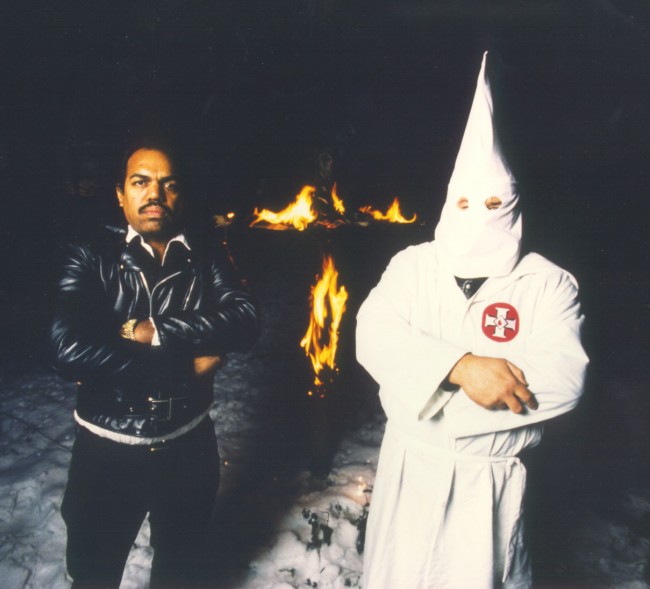
DD-at-KKK-Rally-in-Maryland-650x589Everyone gravitates toward people and people groups that are “like us”. We see it in all facets of life. The tendency to associate with our “own kind” begins early in life, on the playground. Kids tend to form cliques. They give themselves names like, jocks, nerds goths, burnouts,  and so on. Consider the classic “no girls allowed” sign under the treehouse.

This tendency is very human. The athletes stick together; the smart kids stick together; fraternities and sororities stick together; Italians, Irish, Mexicans, whatever people make up the current immigrant wave, stick together. The poor associate with the poor, and the rich associate with the rich.

The racial divide is, perhaps, the most ugly example of this tendency in our country, and one that we still deal with after many years of “equal protection under the law” and civil rights movements and ant-discrimination statutes. Continue reading